Extreme Animals

Primed for survival: How sea hares inspire new clues to protect the brain from low oxygen conditions such as stroke

Sea hares (Aplysia californica) live in coastal environments where oxygen levels can fluctuate unpredictably. Knowing this, researchers set out to explore how these animals tolerate regular exposure to hypoxia (low oxygen) with the hope of discovering clues that could teach us how to protect humans from hypoxia-related conditions, such as stroke. To do this, they compared offspring from two types of parents: those collected from the wild that likely experienced […]


Continue Reading →

From firefighting foam to feathers: Tracking PFAS in nature

It seems that we are learning more every day about potential exposure to “forever chemicals”, such as PFAS. From proposed laws in California that would ban PFAS in cookware and other items to maps such as the one above showing potential contamination in tap water. These chemicals are drawing so much attention because they do not break down easily and can remain in the environment for decades. In addition, PFAS […]

Continue Reading →

Brown adipose tissue: not just a heater or fat-burning machine

Once dismissed as a feature only babies possess, brown adipose tissue (BAT), is widely recognized as the body’s metabolism-boosting, heat-generating fat. This Time Machine episode takes a look back at early research and new discoveries about this metabolism-boosting fat. According to a 2007 paper published in the American Journal of Physiology – Endocrinology and Metabolism, it was the ability for BAT to take up glucose that enabled its discovery in […]

Continue Reading →

Mosquitoes suck! (and pee, too)

As if sucking our blood wasn’t bad enough, I was horrified to learn that mosquitoes also pee on us while they’re drinking. Yuck! In this time machine, we revisit a 1987 paper published in Physiology that explains why. Female mosquitoes require blood meals to obtain the proteins necessary for egg production. During a single meal, they can consume up to twice their body mass in blood. That’s like a 150-pound […]

Continue Reading →

Red, White, and Bison: Celebrating Freedom and National Bison Month

Happy 4th of July! What a perfect time to also honor National Bison Month! This month, we celebrate an icon of the American landscape. Bison are incredible animals, not just for their symbolic significance but also for their remarkable adaptations to extreme environments. As highlighted by the National Park Service’s Bison Bellows, their resilience in the face of brutal winters is extraordinary. Bison are uniquely adapted to harsh winter conditions […]

Continue Reading →

Time Machine: Is lactic acid really to blame for muscle fatigue?

Have you ever experienced muscle fatigue? You know the feeling where your muscles start to burn and no matter how hard you try, you simply cannot summon any more strength? It is often assumed that the burning sensation associated with muscle fatigue is due to lactic acid building up in the muscles. But is that the full story? In this time machine post, we examine the science behind muscle fatigue […]

Continue Reading →

Ocean oddity: how teleost fish stay hydrated in saltwater

It may sound strange to hear that saltwater fish need to stay hydrated. After all, they live in water. However, a review published in Physiology describes how nearly all saltwater fish are thought to have evolved from freshwater ancestors, and many maintain similar levels of salt in their blood as freshwater animals. Living in a saltwater environment means that these fish have to find a way to get rid of […]

Continue Reading →

Muscle adaptations to endurance exercise

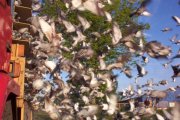
Happy Pigeon Appreciation Day! Okay, I know it sounds strange to celebrate pigeons – the animal best known for gathering in large numbers, causing a raucous, as well as perching and pooping on just about everything. For just a moment though, I would like to consider the unique athletic attributes of these popcorn and park loving birds vs humans engaged in endurance exercise. Have you ever heard of pigeon racing […]

Continue Reading →

Discovered by accident: Queen bumblebees can hibernate underwater!

Dr. Sabrina Rondeau, a postdoctoral fellow at the University of Ottawa, made a surprising discovery that has created quite the buzz. While checking on queen bumblebees hibernating in the refrigerator, she noticed that condensation had formed inside some of the containers housing the queen bumblebees. Interestingly, the bees survived the ordeal. Intrigued by how exposure to water might affect queen bees during hibernation, Dr. Rondeau conducted an experiment in Bombus […]

Continue Reading →

“Hummingbirds of the Night”

A reference to nectar-feeding bats as “hummingbirds of the night” in a presentation at the 2025 American Physiology Summit in Baltimore last month caught my eye. What an appropriate nickname for bats that can have blood sugar levels exceeding 750 mg/dl after a meal! Sure, a hummingbird would think this was normal, but for a human these levels would warrant a trip to the emergency room. New research shared by […]

Continue Reading →