Extreme Animals

Gut-temperature axis in high altitude deer mice?

Dr. Graham Scott (McMaster University) presented intriguing research at the American Physiology Summit earlier this month in Long Beach, CA. His laboratory has been examining a potential link between the gut microbiome and the ability for deer mice to help regulate body temperature. Deer mice live in high elevations where atmospheric oxygen levels are low. This presents a physiological challenge as they have to use a lot of energy to […]


Continue Reading →

Flexible hypoxia tolerance in frogs

In a new study published in The Journal of Neuroscience and presented at the American Physiology Summit earlier this month, graduate student Nikolaus Bueschke, postdoctoral fellow Dr. Lara Amaral-Silva and Dr. Joseph Santin (University of Missouri, Columbia) together with researchers Min Hu and Alvaro Alvarez (University of North Carolina at Greensboro), explored how bullfrogs (Lithobates catesbeianus) emerging from hibernation tolerate hypoxia while they kickstart physiological functions in ice-covered ponds. This […]

Continue Reading →

Guest Blog: Fasting as a strategy to build athletic diving capacity

Kaitlin Allen is a graduate student at the University of California, Berkeley where she studies the physiology of elephant seals in the laboratory of Dr. José Pablo Vázquez-Medina. She received the 2024 Dr. Dolittle Travel Award from the Comparative and Evolutionary Physiology section of the American Physiological Society to attend the 2024 American Physiology Summit in Long Beach, CA (April 4-7). Kaitlin prepared this award-winning guest blog entry to describe […]

Continue Reading →

Nematodes exhibit signs of cancer resilience

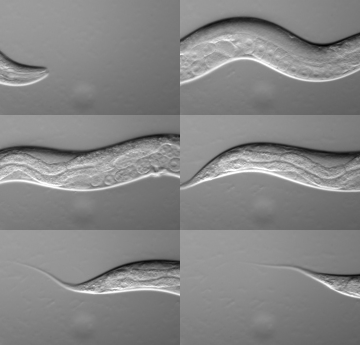
Like the wolves of Chernobyl, small nematodes (Oscheius tipulae) in the area appear to be resistant to developing radiation-induced genetic mutations. In fact, scientists have been unable to detect any changes in their genome, in comparison to individuals living in other parts of the world, despite their highly radioactive environment. Source: SC Tintori, D Cağlar, P Ortiz, MV Rockman. Environmental radiation exposure at Chornobyl has not systematically affected the genomes […]

Continue Reading →

Some organisms self-destruct after reproduction

Most mammals are iteroparous, meaning they can undergo multiple cycles of reproduction and gradually advance in age. In stark contrast, semelparous species only reproduce once before they die, as the physiological toll of mating is quite high. Examples of semelparous species include Pacific salmon, which swim upstream where they die after spawning, thus becoming nutrients for their own offspring and the environment. By only 10 months of age, male kalutas […]

Continue Reading →

New research shows that muscles in hibernating animals consume energy

Hibernation allows animals to reduce their energy needs during winter, when food may be scarce and high amounts of energy would be required to maintain body temperature. These animals prepare for winter by storing body fat that can be used as fuel during hibernation. Skeletal muscles in particular have high energy needs as they make up nearly half of an animal’s body mass. They also play important roles in regulating […]

Continue Reading →

Roses are red, violets are blue, beluga whales and dolphins have higher carbon monoxide than you

The lifespan of a red blood cell (RBC) in a healthy human is about 120 days and approximately 200 billion red blood cells (RBCs) are replaced every day in healthy adult humans! Most (80%) of the carbon monoxide produced in humans comes from the breakdown of heme which is released when these red blood cells (RBC) are broken down through normal homeostatic processes. Sickle cell anemia shortens the lifespan of […]

Continue Reading →

Adapting to a fruit diet

In an interesting new study published in Nature Communications, researchers compared gene expression of Jamaican fruit bats (Artibeus jamaicensis) and insectivorous big brown bats (Eptesicus fuscus) to humans with diabetes. Fruit eating bats, in particular, intrigued researchers as their diet is high in sugars requiring the animals to rapidly regulate glucose to prevent diabetes-like complications. In fact, fruit bats are able to lower their blood sugar faster after a meal […]

Continue Reading →

“Gatorcicles”

Freezing temperatures are no match for alligators. Recent images emerging from Texas and North Carolina show frozen ponds and swamps dotted with alligators. Similar to animals that experience torpor, alligators are able to reduce their metabolism and heart rate to as little as three beats per minute to survive freezing temperatures. This torpor-like state is called brumation. Poking their snouts above the ice before it freezes, allows them to continue […]

Continue Reading →

Keeping fur clean

Dr. Andrew Dickerson and colleagues at the University of Tennessee wondered why underwater surfaces collect algae and bacteria whereas the fur of semiaquatic mammals, such as otters and beavers, do not. The collection of bacteria, slime, plants, and organisms such as mussels on underwater surfaces is called “biofouling” In a new study, scientists discovered that the fur of semiaquatic animals has a unique property: each hair is able to move […]

Continue Reading →