Illnesses and Injuries

Physiology on the Road: What’s happening in the Midlands

The Midlands Society of Physiological Sciences held their annual conference on October 21st at the University of Nebraska Medical Center. The Keynote Lecture was given by Dr. Manolis Kellis, Professor at Massachusetts Institute of Technology. He spoke about the use of artificial intelligence approaches to examine how fly and human genes are regulated. Other highlights: Anuj Singh (University of Nebraska Medical Center): Opioid use is a major healthcare concern and […]


Continue Reading →

Physiology on the Road: “Physiology in Ohio, The Heart of it All!”

The Ohio Physiological Society met October 6-7th at The University of Toledo located in Toledo, OH. True to the name of this year’s conference, the Keynote address was given by Dr. Joseph Wu, Director of the Stanford Cardiovascular Institute and current president of the American Heart Association. His research focuses on congenital heart disease in adults as well as cardiovascular imaging. His most recent clinical trials involve testing bone-derived stem […]

Continue Reading →

Physiology on the road: What’s happening in Missouri

This time of year is perfect for catching up on local physiology news. For the next few posts, we are going to take a tour around the country to learn what’s going on in some of the chapters of the American Physiological Society… First stop: the Missouri Physiological Society, otherwise known as “mophys”. Mophys is an independent chapter of the American Physiological Society. They held their annual meeting on September […]

Continue Reading →

Immune to cancer

Bats are known for their strong immune systems and impressive longevity. In fact, some species live 20 years or more in the wild. Unlike many long-lived species, however, cancer is a rare occurrence in bats. A new study published in Genome Biology and Evolution examined the link between immune function and cancer resistance in bats. The team characterized the genome of Jamaican fruit bats (Artibeus jamaicensis) and Mesoamerican mustached bats […]

Continue Reading →

The physiology of ‘frogsicles’ and the quest for life after death

Cope’s gray treefrogs, Dryophytes chrysoscelis, are remarkable animals that can actually survive being frozen…multiple times each year. In fact, these animals live in an environment in which temperatures commonly dip below freezing. When temperatures drop, up to 65% of their body water literally freezes. In anticipation of freezing temperatures, they begin to accumulate cryoprotectant chemicals during the fall to help protect their organs. Until now, the effects of repeated cycles […]

Continue Reading →

Nature’s medicines

Although they look furry and fun to pet, larvae of asp caterpillars (like the one pictured above) would inflict pain on anyone bold enough to touch them. Underneath their “fur” lay venomous spines containing toxins that cause intense burning pain. Although other caterpillars and insects are also venomous, the particular venom produced by asp caterpillars is different. In fact, researchers at the University of Queensland in Australia think that these […]

Continue Reading →

Sniffing out pathogens

Rainbow trout are able to mount an immune response after simply smelling a virus or bacteria, even before they are infected. In a new study shared at the 2023 American Physiology Summit, researchers examined whether smell-induced activation of the immune response also triggers avoidance behaviors in the fish. By creating a maze that included a pathogen at one end, they discovered that the fish do in fact avoid the smell […]

Continue Reading →

Hydrogen sulfide – the gas we hate to smell, but can’t live without

Although hydrogen sulfide (H2S) is most often associated with manure and the smells of rotten eggs, research has shown it plays important physiological roles. In fact, our bodies actually produce H2S within our cells. Other source of H2S include sulfate-producing bacteria in our gut and dietary intake (such as garlic and cruciferous vegetables). H2S is a member of a group of gasotransmitters, referred to as the ‘reactive species interactome’, that […]

Continue Reading →

How snakes fight infection quickly

In honor of St. Patrick’s Day today, I thought we’d talk about snakes today. Vertebrates defend themselves from infections with the help of the adaptive and innate immune systems. The first responder to an infection is typically the innate immune system, which is not specific to a particular pathogen. This system helps to prevent the infection from spreading and uses various toxins to kill pathogens. The adaptive immune response, on […]

Continue Reading →

The biological importance of carbonic anhydrase enzyme

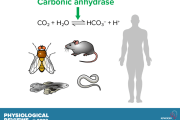
Carbonic anhydrase is an important enzyme that regulates the acid-base balance of an organism. In fact, carbonic anhydrase (CA) is so important to homeostasis, it is found in all living organisms studied to date – from microorganisms (like bacteria) to mammals. As the name implies, this enzyme is responsible for catalyzing the hydration of carbon dioxide, which is a reversible process (see figure above). In other words, it speeds up […]

Continue Reading →