
Nature’s Solutions

Ohio talks about physiology and disease

Researchers from around the state of Ohio met today at the 34th annual Ohio Physiological Society meeting to discuss their research. Although many of the presentations were not on comparative physiology topics, I found some particularly interesting and thought I would share them with you anyway. Here goes: Dr. Katherine Vest and her research team (Kierra Ware, Yu Zhang, Thomas Whitlow) from the University of Cincinnati College of Medicine presented their research on […]
Continue Reading →

Remarkable hypoxia and cold tolerance of rodents native to the Tibetan plateau

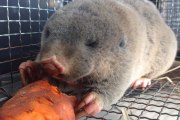
The plateau zokor (Eospalax baileyi) is an underground dwelling rodent species native to the Tibetan plateau (2000-4200 meters in elevation). A new study published in the American Journal of Physiology – Regulatory, Integrative and Comparative Physiology explored how these animals were adapted to extract oxygen from an environment with very low levels (83-88% of atmospheric). Hemoglobin molecules found in red blood cells are responsible for binding oxygen and transporting it to tissues […]

Continue Reading →

High altitude deer mice have less stress?

Animals that live at high altitude have evolved a number of physiological adaptations to deal with the low atmospheric oxygen concentrations (hypoxia). For low altitude acclimated animals, short exposures to high altitude results in activation of the sympathetic nervous system (i.e. the fight or flight response). This is a good thing because activation of this system results in more blood flow, especially to the heart and brain to help protect oxygen […]

Continue Reading →

Did you know just how interesting shark rectal glands could be?

In case you missed Shark Week this year, I thought I would mention a cool fact about dogfish sharks (Squalus acanthias) that you probably did not learn about. I read an interesting article from a lecture given by Dr. John N Forrest Jr, M.D. that was published in 2016 in Transactions of the American Clinical and Climatological Association. Sharks have a complicated system for regulating water and salt balance in the […]

Continue Reading →

Rapid switches in metabolism of hibernating animals

  In a new study published in the American Journal of Physiology – Regulatory, Integrative and Comparative Physiology, researchers examined how changes in metabolism during torpor are regulated in 13-lined ground squirrels (Ictidomys tridecemlineatus). During hibernation, these animals cycle between bouts of torpor (about 2 weeks each) when their metabolism is reduced by 95% and body temperature can drop to 5degC and short states of interbout euthermia when both temperature […]

Continue Reading →

Editor’s picks for 2018

The Editor’s Picks for 2018 have been released for the American Journal of Physiology – Regulatory, Integrative and Comparative Physiology. According to the editorial team, the focus of this journal is on “the regulation of whole organismal function that requires the interplay of multiple organ and tissue systems.” The top comparative physiology articles of 2018 included: An article by Hersh et al., who provided evidence that little skates may be useful […]

Continue Reading →

Chronic pain after an injury

A new study published in Science Advances reveals that fruit flies may feel chronic pain after an injury. While researchers have known that insects can feel pain (evidenced by their avoidance of stimuli that may be perceived as painful), they did not know whether insects developed chronic pain like people sometimes do after an injury. The research team studied fruit flies with an amputated leg resulting in damage to the […]

Continue Reading →

Birds have a unique way of preventing muscle wasting

Muscle wasting is a major complication associated with cirrhosis and liver failure. Normally the liver functions to convert ammonia into urea. But with liver failure, this process does not work well leading to high levels of circulating ammonia, which is thought to contribute to muscle wasting in mammals. A new study published in the American Journal of Physiology – Regulatory, Integrative and Comparative Physiology, explored whether birds have the same muscle wasting […]

Continue Reading →

Working towards prolonged spaceflight

Spaceflight has always fascinated me. While long distance spaceflight looks so routine in science fiction shows, the reality is much different as we have yet to conquer the complications surrounding long duration deep-space flight. One issue is how to feed astronauts traveling long distances as we do not yet have replicator technologies. If we did, I would have coffee whenever I wanted it. In a new article published in Physiology, […]

Continue Reading →

Highlights from the last day in Orlando

Today marked the final day of the 2019 Experimental Biology meeting in Orlando. As usual it was a great day for Physiology. Crupi et al., from the University of Messina and the Universita della Magna Grecia in Italy put up a poster presentation describing their research on how red blood cells respond to environmental toxins. Their research showed that isolated red blood cells from rabbits are more sensitive to venoms […]

Continue Reading →