Stress

Some organisms self-destruct after reproduction
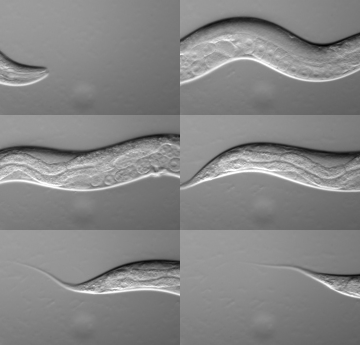
Most mammals are iteroparous, meaning they can undergo multiple cycles of reproduction and gradually advance in age. In stark contrast, semelparous species only reproduce once before they die, as the physiological toll of mating is quite high. Examples of semelparous species include Pacific salmon, which swim upstream where they die after spawning, thus becoming nutrients for their own offspring and the environment. By only 10 months of age, male kalutas […]

Continue Reading →

Improving the health of fish exposed to arsenic and increasing environmental temperatures

Speaking of stress…scientists at the ICAR – National Institute of Abiotic Stress Management in India are exploring the use of dietary copper to help reduce stress and improve the health of fish exposed to environmental pollutants such as arsenic. Copper is an essential element for animals and humans. It is involved in bone formation and growth, nervous system function, metabolism, immune system function, and antioxidant production.1 Warming aquatic temperatures are […]

Continue Reading →

Physiology on the road: What’s happening in Arizona

The Arizona Physiological Society held their 16th annual meeting this past weekend at Midwestern University in Glendale, Arizona. The Arizona Established Scientist Keynote Speaker was Dr. Christopher Glembotski, Professor of Internal Medicine and Director of the Translational Cardiovascular Research Center at the University of Arizona, Phoenix campus. Ischemic diseases, such as strokes and heart attacks, disrupt the normal functioning of the endoplasmic reticulum, which alters protein production and folding. His […]

Continue Reading →

Physiology on the Road: What’s happening in the Midlands

The Midlands Society of Physiological Sciences held their annual conference on October 21st at the University of Nebraska Medical Center. The Keynote Lecture was given by Dr. Manolis Kellis, Professor at Massachusetts Institute of Technology. He spoke about the use of artificial intelligence approaches to examine how fly and human genes are regulated. Other highlights: Anuj Singh (University of Nebraska Medical Center): Opioid use is a major healthcare concern and […]

Continue Reading →

Meet the honey possum

Meet the honey possum (Tarsipes rostratus). These animals are small and rather unusual marsupials with few teeth and a specially adapted tongue to aid in the consumption of a diet consisting of only nectar and pollen. Because they feed primarily at night, rely on fresh flowers, and tend to stress easily, they are difficult to study. In fact, their adrenal gland, which produces the stress hormone cortisol, weighs about 1,600 […]

Continue Reading →

Mechanisms behind hornworm self-defense discussed at the 2023 American Physiology Summit

Graduate student Christian Valtierra presented research conducted in Dr. Megumi Fuse’s lab (San Francisco State University) at the 2023 American Physiology Summit last month. The research was focused on examining the defensive strike response in Manduca sexta hornworms. Animals respond to potentially damaging stimuli with the help of sensory neurons, called nociceptors, that specialize in detecting these stimuli. In humans, activation of these receptors is what causes us to perceive […]

Continue Reading →

One reason why fish and mammals lose their appetite during stress

I don’t know about you, but sometimes I lose my appetite when I am really stressed. The endocrine system is responsible for controlling our stress responses and involves three main endocrine glands – the hypothalamus, pituitary, and adrenal gland. Hence, the stress pathway is often referred to as the “HPA axis”. When we are stressed, the hypothalamus releases a hormone called corticotropin releasing factor (CRF), which triggers the release of […]

Continue Reading →

Chronic stress during pregnancy increases risk of stillbirth and preterm delivery

At the end of pregnancy, levels of the hormone oxytocin increase to stimulate parturition, or childbirth. The stress hormone cortisol is also important for normal fetal development and, like oxytocin, cortisol increases at the end of pregnancy. This may help explain why chronic stress during pregnancy increases the risk of complications such as stillbirth.   A new study published in the American Journal of Physiology – Regulatory, Integrative and Comparative […]

Continue Reading →

EB 2022: Adapting to a changing climate

EB 2022 was a fantastic meeting (as usual) for comparative physiology. This meeting marked the last Experimental Biology conference as each society will be hosting their own meetings going forward. I soaked up as much as I could and will be sharing what I learned at the meeting over the coming weeks. “Predicting Species Physiological Responses to a Changing Climate” The first speaker in this symposium was Dr. Hollie Putnam […]

Continue Reading →

2022 August Krogh Distinguished Lecturer, Dr. Patricia Schulte

Each year, the Comparative and Evolutionary Physiology section of the American Physiological Society presents their highest award, the August Krogh Distinguished Lecture, to a comparative physiologist who “has made major and meritorious contributions” to the field. Dr. August Krogh (1874-1949) was a physiologist who won the Nobel Prize in Physiology or Medicine in 1920. He was very interested in zoology and joined the University of Copenhagen as an Associate Professor […]

Continue Reading →