Tag Archive for ‘bird’

Gynandromorphs

Talking about having a split personality. A recent story from Live Science reported on a half male/half female chimera cardinal that was discovered in Pennsylvania (pictured below). Not only are the bird’s feathers split (red feathers are found among male and tan among female cardinals), typically the brain is also split. This type of a split sexuality is termed gynandromorph. According to the article, this  anomaly has been observed in birds, […]
Continue Reading →

Lack of sleep stresses out birds too

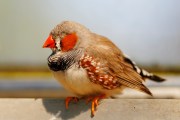
Birds show signs of stress resulting from sleep loss. A new study published in Physiological and Biochemical Zoology shows that zebra finches who are sleep deprived have increased expression of inflammatory genes in their fat tissues, spleen and hippocampus region of the brain along with  increased levels of circulating stress hormones. The hippocampus is the region of the brain associated with long term memory formation. I wonder if sleep deprived birds are […]

Continue Reading →

Watch out T Rex…

Researchers used supercomputers in a new study to see who had the toughest bite…the winner? ….drumroll… the finch! By examining bite force and body mass, researchers found that if finches were the same size as a T Rex, their bite would be 320 times stronger than the ancient dinosaur’s bite. In fact, finches evolved amazing bite strength given their small body size. Source: Live Science  

Continue Reading →

What’s up with those lung valves?

The Plenary Lecture at this year’s Comparative Physiology meeting was given by Dr. Colleen Farmer at Trinity College in Dublin who spoke about the diversity of vertebrate respiratory systems including aerodynamic valves that are found in birds and various species of reptiles. These aerodynamic valves allow air to flow in one direction during both inspiration and expiration as opposed to bidirectional flow in mammals. Examination of red-eared sliders (shown above) […]

Continue Reading →

Physiology in Arizona – Part 1

This past weekend the Arizona Physiological Society held their 11th annual conference on the Tempe campus of Arizona State University. There were so many oral and poster presentations on comparative physiology that I will spend this entry focusing on the oral sessions. The Keynote address was given by Dr. Michael Joyner (Mayo Clinic, Rochester) who spoke about the importance of not just focusing research efforts on reductionist approaches, including many […]

Continue Reading →

How bird eggs got their shape

Ever wonder why bird eggs are shaped the way they are and what drives the variations in egg shapes across species? I never really wondered that either until I saw an article in Science that explained a possible reason…then I just HAD to know. Some theories had been proposed suggesting that their shape prevented eggs from rolling out of nests or otherwise sustaining damage, and so on. According to the new study, the […]

Continue Reading →

Zebra finches reward themselves for singing well

Dopamine is an important hormone released from neurons involved in reward pathways. Researchers at Cornell University wanted to know if dopamine signaling was involved in how birds learn songs. Their findings, recently published in Science, present evidence that neurons in the brain of zebra finches do in fact decrease dopamine signals when the birds hear an error in their song in comparison to when they sing ‘correctly’. The researchers also found […]

Continue Reading →

Pigeons can identify words

A study recently published in the Proceedings of the National Academy of Sciences provides evidence that pigeons can learn to recognize words. That is after the birds were trained over a period of 8 months. According to the study authors “The pigeons’ performance is actually more comparable to that of literate humans than baboons’ performance.” To read, we must be about to decode letters and the sounds they make as […]

Continue Reading →

Big-brained birds

Birds get such a bad rap when it comes to intelligence. Sure they have relatively small brains, but scientists have known they are similar to primates with respect to their cognitive abilities. New research published in the Proceedings of the National Academy of Sciences presents data showing how this apparent dichotomy is possible. They found that the brains of songbirds and parrots pack two times the number of neurons as a primate […]

Continue Reading →