Tag Archive for ‘health’

Muscle adaptations to endurance exercise
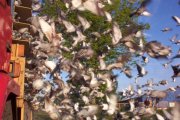
Happy Pigeon Appreciation Day! Okay, I know it sounds strange to celebrate pigeons – the animal best known for gathering in large numbers, causing a raucous, as well as perching and pooping on just about everything. For just a moment though, I would like to consider the unique athletic attributes of these popcorn and park loving birds vs humans engaged in endurance exercise. Have you ever heard of pigeon racing […]

Continue Reading →

Time Machine: Keeping it hot…or not

In todays’ Time Machine, we are taking a look back at a paper written by Dr. Henry Gray Barbour during his time in the Department of Pharmacology at Yale University School of Medicine. Published in Physiological Reviews in 1921, his paper examined how body heat is regulated in various species. In this review, Dr. Barbour explains that water is the best medium for conducting heat throughout the body. This is […]

Continue Reading →

“Hummingbirds of the Night”

A reference to nectar-feeding bats as “hummingbirds of the night” in a presentation at the 2025 American Physiology Summit in Baltimore last month caught my eye. What an appropriate nickname for bats that can have blood sugar levels exceeding 750 mg/dl after a meal! Sure, a hummingbird would think this was normal, but for a human these levels would warrant a trip to the emergency room. New research shared by […]

Continue Reading →

The electrophysiology of sudden cardiac death in high-performance athletes

Humans and racehorses have something in common when it comes to risk of sudden cardiac death. In fact, sudden cardiac death is the 2nd most common cause of death during exercise among these athletes. Although rare, it typically affects young, seemingly healthy individuals. Research suggests that exercise itself is not to blame, but rather an underlying predisposition for irregular heart rates that exercise uncovers. The most common inherited causes of […]

Continue Reading →

Some like it hot: Genetic twists in warm hibernation

Hibernation was also a hot…I mean warm…topic at the American Physiology Summit last month in Baltimore, MD. Thomas Crippen presented research conducted with team members Dr. Dylan Barth, Zac Carlson, Dr. Frank van Breukelen, and Dr. Allyson Hindle at the University of Nevada, Las Vegas. Their study focused on golden-mantled ground squirrels, Callospermophilus lateralis, which are remarkable even among hibernators. These squirrels can enter torpor across a range of environmental […]

Continue Reading →

No air? No problem: Nature’s ultimate survivalists

Hypoxia and anoxia tolerance was a hot topic at the 2025 American Physiology Summit last month. Here are the highlights: Hafsa Yaseen and Natalie Anne Heath presented their research from Dr. Joseph Santin’s laboratory at the University of Missouri exploring how adult bullfrogs (Aquarana catesbeianus) protect their brain function following hibernation, a period when oxygen and glucose levels are often very low. The team discovered that bullfrogs could adjust their […]

Continue Reading →

Weddell seals dampen inflammatory response to combat dive induced hypoxemia injury

We are very excited to share this winning guest blog post from Amy Klink, doctoral student at the University of Nevada – Las Vegas. Amy received the Dr. Dolittle travel award to present this research at the 2025 American Physiology Summit in Baltimore. Congratulations Amy! As a kid growing up in Lake County, Illinois, I spent more than half of my summer in some lake or body of water competing […]

Continue Reading →

Physiology on the road: Celebrating physiology in Indiana

I am excited to announce that the Indiana Physiological Society, a chapter of the American Physiological Society, is hosting their annual meeting tomorrow! The event will take place at the University of Southern Indiana. The keynote address will be given by Dr. Thad Wilson, renowned professor of physiology and educator at the University of Kentucky College of Medicine. The conference also includes hands-on activities to improve teaching in physiology. It […]

Continue Reading →

New study explores whether diet and blood sugar affect cancer risk

A new study published by researchers at Arizona State University, led by Dr. Carlo Maley, in Nature Communications set out to examine whether vertebrates that have high blood sugar are at greater risk of developing cancer. The current study follows on the heels of prior work by his team that was published in Evolution, Medicine, and Public Health last summer showing that cancer prevalence is lower in birds than other […]

Continue Reading →

Surviving the heat: How humans and animals adapt to hot environments

Heat is a major physiological stressor that can damage proteins in the body, promote dehydration and even lead to death. Organisms living in hot environments must develop both behavioral and physiological mechanisms to prevent heat-related damage or illness. A recent review published in Physiology examined how humans and experimental animals adapt to heat (Laitano et al., 2025).    Organisms that tolerate heat effectively can maintain normal physiological functions even when […]

Continue Reading →