Extreme Animals

Hagfish 101: How to eat a whale from the inside out

The Dr. Dolittle award is given to outstanding graduate students or postdoctoral fellows who are conducting comparative physiology research that they are presenting at the annual Experimental Biology conference. Applicants for the award are asked to submit guest blog posts describing their research. I am very pleased to share this guest blog post from this year’s Dr. Dolittle travel award recipient, Alyssa Weinrauch. Alyssa presented her research today the Experimental […]
Continue Reading →

Very high intensity exercise: hovering

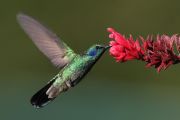
I just read an interesting review published in Physiology of flight energetics and fuel use in nectar feeding hummingbirds and bats. While flight is considered pretty high intensity exercise, hovering flight is even more demanding. Hummingbirds and nectar feeding bats are really tiny and thus have very high metabolisms to maintain body heat. Some of these animals are also migratory, which is an even greater energy demand. Remarkably, they sustain […]

Continue Reading →

Study shows warm-blooded animals adapt better to climate changes

A new study published in Nature Ecology and Evolution looked at fossil records, current distributions and the phylogenetic relationships for over 11,000 terrestrial vertebrates. Using historical records to reconstruct climate and geographical ranges they found that birds and mammals were more successful and faster than cold-blooded animals at adapting to climate changes as well as expanding or changing the location or range of their habitats. In a quote from Scientific American, […]

Continue Reading →

Dr. Hannah Carey in the spotlight

Congratulations Dr. Hannah Carey, 80th President of the American Physiological Society (2007-2008) and fellow of the American Association for the Advancement of Sciences, which recently interviewed her about her research on hibernation.  Dr. Carey is a comparative physiologist and professor of Comparative Biosciences at the University of Wisconsin School of Veterinary Medicine. Her current research focus is on how the gut microbes of 13-lined ground squirrels change during hibernation. According […]

Continue Reading →

Man catches rare warm-blooded fish

This past weekend a man caught a very rare fish, called an opah (aka moonfish), off the coast of Ocean City, Maryland. What makes this fish so rare is that it is the only known warm-blooded fish. In fact, they are able to keep their whole body about 5 degrees Celsius above the water they swim in. Other fish lose heat generated from muscle movements to the environment as the […]

Continue Reading →

Pallid bats vs Arizona Bark Scorpions

I don’t know about you, but I am terrified of scorpions.  As if scorpions were not spooky enough, the Arizona bark scorpion (Centruroides sculpturatus) is the most venomous scorpion in North America. Gulp. Enter the pallid bat. Clearly not as intimidated, pallid bats (Antrozous pallidus) often dine on Arizona bark scorpions. Researchers at the University of California at Riverside wanted to examine whether the bats were truly resistant to the […]

Continue Reading →

New species of giant rat discovered in Solomon Islands

A new species of giant tree rats (Uromys vika) has been confirmed in the Solomon Islands! These rats can reach over 2 pounds and an impressive 1.5 feet in length. They can even break through coconuts with their teeth. I would not want to cross paths with one of these critters. Sources: Video: YouTube TH Lavery, H Judge. A new species of giant rat (Muridae, Uromys) from Vangunu, Solomon Islands. […]

Continue Reading →

Pigeons outperform humans when it comes to multitasking

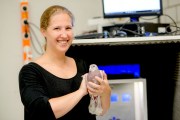
Sara Letzner had humans compete against pigeons in a behavioural experiment. Photo from: Ruhr-Universitat at Bochum A new study conducted by Drs. Sara Letzner and Onur Gunturkun (Ruhr-Universitat at Bochum) as well as Dr. Christian Beste (Technische Univeritat at Dresden) shows that pigeons are better than humans when it comes to multitasking. Their findings were published in Current Biology. The findings from the study show that the mammalian cerebral cortex, with […]

Continue Reading →

Fasting as a survival strategy in animals

Although female northern elephant seals only typically deliver one pup, females will sometimes nurse offspring from other mothers as in this photo by Brocken Inaglory via Wikimedia commons. A situation like this would result in less milk available to each nursing pup. I just read an interesting paper published in Physiology. Animals periodically undergo periods of food deprivation such as during hibernation, mating, molting and migration. During these period of […]

Continue Reading →

Do Mexican cavefish hold the secret to treating diabetes?

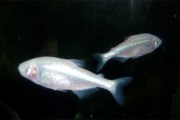
Mexican tetra (Astyanax mexicanus) are a fascinating example of divergent evolution. Over time, some of these freshwater river fish washed into caves where they continue to live. With perpetual darkness, these cavefish have lost their ability to see along with their skin pigmentation. Oxygen and food are also hard to come by in the caves. In fact, the cave dwelling fish may go for months without eating as they wait […]

Continue Reading →