Ocean Life

Dr. Terrie Williams, 2019 August Krogh Distinguished Lecture

This year’s August Krogh Distinguished Lecture was awarded to Dr. Terrie Williams from the University of California at Santa Cruz. She gave an excellent lecture on her research with dolphins, narwhals and Weddell seals examining their physiological responses to diving, which includes a remarkable ability to reduce heart rate. He current research is aimed at identifying physiological mechanisms that could explain the increasing incidence of cetaceans becoming stranded on beaches […]

Continue Reading →

Highlights from EB 2019

There were so many poster presentations on comparative and evolutionary physiology today at the 2019 Experimental Biology conference that it was impossible to see them all. Here are some highlights: Dr. Michael Hedrick from California State University – East Bay, presented his research on African cheetahs (Acinonyx jubatus) examining adaptations that cheetahs have evolved to supply their muscles with oxygen so efficiently, given they maintain the world record for being […]

Continue Reading →

Do octopuses (and other animals) dream?

Video captured by Rebecca Otey (via YouTube) at the Butterfly Pavilion in Colorado seems to suggest that perhaps octopuses dream in their sleep: Although it is not clear whether octopuses really are dreaming when they change colors in their sleep, researchers at the World Science Festival in 2011 discussed work studying changes in brain activity of animals during sleep compared to wakefulness to gauge whether they may be dreaming:

Continue Reading →

Carnivorous fish are glucose intolerant

Who would have thought that carnivorous fish, like the gilthead sea bream pictured above, and people with diabetes have a lot in common? These fish are glucose intolerant, meaning they are not able to use glucose for energy very well. When these fish are given carbohydrates, their blood sugar increases as does their ability to produce fats through lipogenesis. The purpose of this increase may be to store the excess […]

Continue Reading →

Ohio is talking about fixing broken hearts, the physiology of freezing, combating opioid addiction and more

The Ohio Physiological Society held their 33rd Annual Meeting at the University of Cincinnati this weekend. The keynote address was given by Dr. Mark Sussman from San Diego State University. He spoke about current research strategies that aim to improve the ability for the heart to repair itself after heart failure. Dr. Perwez Alam (University of Cincinnati) also spoke about using siRNA to try to repair heart tissue after heart attacks and […]

Continue Reading →

Seals have anti-inflammatory blood

Dr. Allyson Hindle from Massachusetts General Hospital in Boston, presented some interesting research on seals at the Experimental Biology conference this week in San Diego. Seals are known for being rather plump, which for humans often leads to inflammation and cardiovascular disease. In addition, seals undergo repeated bouts of hypoxia and reoxygenation during their dives, which is also known to promote inflammation and cardiovascular disease in humans. Her research team […]

Continue Reading →

What lurks in the water…

Dr. Craig Franklin from the University of Queensland spoke yesterday about his research with crocodiles. After evaluating hundreds of recordings from telemetry instrumentation and satellite tags of the animals, the data showed that crocodiles regulate their body temperature much like fish. This means that crocodile body temperature is often dictated by their surrounding water temperature. Dr. Iskander Ismailov, a Research Assistant Professor from lab of Dr. Michael Friedlander at Virginia […]

Continue Reading →

Seals, seals and more seals

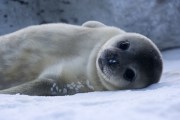
Several of the posters and talks at the Experimental Biology meeting in San Diego focused on Weddell Seals. They are not only cute, they are really interesting physiologically. Emma Weitzner, a graduate student in the lab of Dr. Heather Liwanag, presented a poster on Weddell seals, which are studied as models of the physiology of diving. Emma and her team recorded diving behavior and collected blood samples from 1 week-old […]

Continue Reading →