Tag Archive for ‘Climate Change’

How some fish may compensate for low environmental oxygen

     Adult fish rely on gills to extract oxygen from the surrounding water. Larval fish, on the other hand, do not have well-developed gills and instead rely primarily on gas exchange across their skin.      In a new study published in the American Journal of Physiology – Regulatory, Integrative and Comparative Physiology, researchers examined whether larval fish could use their pectoral fins to increase the flow of water […]

Continue Reading →

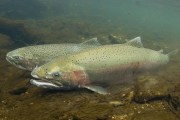
Warm hypoxic waters impair heart function in some fish

Events causing bodies of water to become hypoxic (low oxygen levels) are increasing with climate change. Water can become hypoxic when it warms up or there are changes in tidal flow, density, wind patterns as well as separation from the main source, such as occurs in a tidepool. While some fish are tolerant of hypoxia and even anoxia (oxygen depleted) environments others, such as Atlantic cod and steelhead trout, rely […]

Continue Reading →

Adapting (or not) to increasing temperatures

Birds are not the only animals experiencing massive declines in populations. Rising temperatures and heat waves, in particular, have been blamed for killing humans and animals. In fact, a new review article published in Physiology mentioned that globally, heat is “a significant natural killer of humans, with the first decade of the 21st Century seeing a 23-fold increase in human casualties from heat waves compared with the 1990s.” If current predictions hold true, […]

Continue Reading →

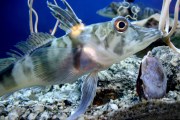
Antarctic icefish do not tolerate rising temperatures

Antarctic finfishes may be facing rising ocean temperatures. This is of particular concern to icefishes, as they are not very tolerant of increasing temperatures. Prior studies have shown that this lack of tolerance may be due to an inability for their hearts to beat normally and actually collapse at higher temperatures. In a study presented at the 34th annual Ohio Physiological meeting at Wright State University today, researchers Evans et al., (working […]

Continue Reading →

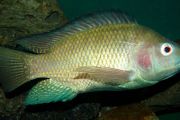
Rising water temperatures masculinizes Nile tilapia

Nile tilapia, Oreochromis niloticus, is a species of freshwater fish native to Egypt and Africa. Global warming has the potential to significantly impact this species as water temperatures above 32 to 36.5 degrees Celsius can induce young fish (10-30 days after fertilization) that are genotypically female to become masculinized. Moreover, a recent study published in PLOS ONE showed that some young fish choose to visit warmer waters. A new study published […]

Continue Reading →

Highlights from EB 2019

There were so many poster presentations on comparative and evolutionary physiology today at the 2019 Experimental Biology conference that it was impossible to see them all. Here are some highlights: Dr. Michael Hedrick from California State University – East Bay, presented his research on African cheetahs (Acinonyx jubatus) examining adaptations that cheetahs have evolved to supply their muscles with oxygen so efficiently, given they maintain the world record for being […]

Continue Reading →

Adapting to rising temperatures

In a new review article published in Physiology, Dr. Jonathon Stillman from San Francisco State University explores how populations of animals and humans may respond to increasing frequency of heat waves. According to Dr. Stillman, the past decade has produced some of the hottest years on record, resulting in the loss of human and animal life. Both the length and intensity of these heat waves are expected to increase, which […]

Continue Reading →

New study shows mussels are “hot and bothered”

Freshwater organisms are especially vulnerable to environmental changes as they are exposed to both atmospheric changes as well as run-off from nearby cities; in particular, rising temperatures and increasing carbon dioxide levels from both natural factors (rainfall, geology, etc) as well as human influence (deforestatin, agriculture, urbanization). For example, studies of rivers around the world have found that carbon dioxide levels vary from 647 – 38,000 µatm. Higher levels are […]

Continue Reading →

Study shows warm-blooded animals adapt better to climate changes

A new study published in Nature Ecology and Evolution looked at fossil records, current distributions and the phylogenetic relationships for over 11,000 terrestrial vertebrates. Using historical records to reconstruct climate and geographical ranges they found that birds and mammals were more successful and faster than cold-blooded animals at adapting to climate changes as well as expanding or changing the location or range of their habitats. In a quote from Scientific American, […]

Continue Reading →