Tag Archive for ‘diving’

Weddell seals dampen inflammatory response to combat dive induced hypoxemia injury

We are very excited to share this winning guest blog post from Amy Klink, doctoral student at the University of Nevada – Las Vegas. Amy received the Dr. Dolittle travel award to present this research at the 2025 American Physiology Summit in Baltimore. Congratulations Amy! As a kid growing up in Lake County, Illinois, I spent more than half of my summer in some lake or body of water competing […]

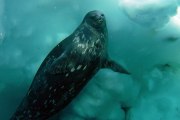
Continue Reading →

New study provides more insight into the physiology of elite divers

If the Olympics allowed marine mammals to compete, they would dominate free diving competitions in terms of breath holding duration and extreme physiology. Marine mammals also have adaptations that help prevent tissue damage from the lack of oxygen during such dives. For example, Weddell and northern elephant seals store large amounts of oxygen in their blood and muscles, thanks to abundant hemoglobin, which permits them to hold their breath for […]

Continue Reading →

Speaking of hypoxia tolerance…

Amy Klink, a graduate student working in the laboratory of Dr. Allyson Hindle at the University of Nevada, Las Vegas, has been studying hypoxia tolerance of Weddell seals. These remarkable animals can hold their breath for 90 minutes and dive as deep as 900 meters! During such long and deep dives, these seals slow down their heart rate and constrict blood vessels in visceral as well as peripheral organs. As […]

Continue Reading →

What sea turtles can teach us about hypoxia tolerance

Imagine being able to explore the Earth’s oceans without needing special oxygen equipment. Loggerhead sea turtles have this ability and can actually hold their breath for up to 7 hours! According to the Guiness Book of World Records, Budimir Šobat from Croatia set the record in 2021 for being able to hold his breath for 24 minutes and 37.36 seconds underwater. While quite remarkable, he would need to hold his […]

Continue Reading →

Guest Blog: Fasting as a strategy to build athletic diving capacity

Kaitlin Allen is a graduate student at the University of California, Berkeley where she studies the physiology of elephant seals in the laboratory of Dr. José Pablo Vázquez-Medina. She received the 2024 Dr. Dolittle Travel Award from the Comparative and Evolutionary Physiology section of the American Physiological Society to attend the 2024 American Physiology Summit in Long Beach, CA (April 4-7). Kaitlin prepared this award-winning guest blog entry to describe […]

Continue Reading →

Roses are red, violets are blue, beluga whales and dolphins have higher carbon monoxide than you

The lifespan of a red blood cell (RBC) in a healthy human is about 120 days and approximately 200 billion red blood cells (RBCs) are replaced every day in healthy adult humans! Most (80%) of the carbon monoxide produced in humans comes from the breakdown of heme which is released when these red blood cells (RBC) are broken down through normal homeostatic processes. Sickle cell anemia shortens the lifespan of […]

Continue Reading →

Extreme Physiology of Diving

Can you imagine what would happen to your body if you dove up to 1700 meters deep in the ocean for an hour and a half, or experienced months of food deprivation? In the case of deep diving, the high pressure causes the collapse of the lungs of terrestrial mammals (including humans!) and depletion of body oxygen stores, whereas long fasting periods compromise health and induce muscle wasting. Northern elephant […]

Continue Reading →

Experimental Biology 2021: Q&A with Dr. Michael Tift and Anna Pearson

We are delighted to speak with Anna Pearson (MS student) and her mentor Dr. Michael Tift, Assistant Professor at the University of North Carolina – Wilmington. Anna presented her research “First report of red blood cell lifespan in a marine mammal: An insight into endogenous carbon monoxide (CO) production” at the 2021 Experimental Biology conference last month. What made you interested in studying red blood cells in dolphins?Dr. Tift became interested […]

Continue Reading →

Physiology of diving animals: how do they deal with hypoxia?

Dr. Jose Pablo Vazquez-Medina (pictured at right), a comparative physiologist at the University of California – Berkeley, was scheduled to present several ongoing studies from his lab at the Experimental Biology conference last month. Dr. Vazquez-Medina is a member of the Comparative and Evolutionary Physiology section of the American Physiological Society. Although the conference was cancelled due to Covid-19, Dr. Vazquez-Medina has agreed to share his research with us.   […]

Continue Reading →

First ever recording of heart rate in free swimming blue whales

While we are on the topic of whales, I found additional research published in the Proceedings of the National Academy of Sciences USA on these animals and how their hearts function that I find fascinating. Talk about extreme physiology! Researchers from Stanford University were able to attach surface electrodes to blue whales using suction cups. This allowed them to measure – for the first time – how heart rate changes during […]

Continue Reading →