Tag Archive for ‘Exercise’

How exercise and age change muscles

When we lift weights or do resistance exercises, our muscles adapt by changing which genes are turned on or off. These genetic changes (called transcriptional changes) help muscles grow stronger and improve their metabolism. Both young and older people experience these changes, but aging changes how muscles respond at the genetic level, which may help explain why older adults don’t gain muscle as easily as younger individuals. In a study […]
Continue Reading →

Muscle adaptations to endurance exercise

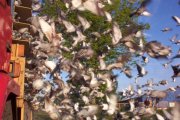
Happy Pigeon Appreciation Day! Okay, I know it sounds strange to celebrate pigeons – the animal best known for gathering in large numbers, causing a raucous, as well as perching and pooping on just about everything. For just a moment though, I would like to consider the unique athletic attributes of these popcorn and park loving birds vs humans engaged in endurance exercise. Have you ever heard of pigeon racing […]

Continue Reading →

Even small birds fly high

Dr. Catherine Ivy (Assistant Professor, University of Saskatchewan, Canada), shared research this morning at the 2025 APS Summit on the remarkable hypoxia tolerance of birds. Although bar-headed geese (above) are the poster-birds for research on extreme hypoxia tolerance, I was surprised to learn that even many small migratory species of birds fly at relatively high altitude. Tiny migratory yellow-rumped warblers (~12g), for example, travel for about 6-8 hours at a […]

Continue Reading →

Brain Power on a Budget: How Bullfrogs Survive Without Oxygen

Did you know that your brain is really greedy? It uses about 5.7 kilograms of ATP every day, which is an incredible amount of energy! To keep up with such demand, the brain depends on an adequate supply of oxygen and nutrients, such as glucose. When oxygen or nutrient delivery are limited, like during a heart attack, stroke or in low-oxygen environments, the brain is unable to produce enough ATP […]

Continue Reading →

Little-known functions of the spleen: Q&A with Dr. Frank van Breukelen and Gilbecca Smith, University of Las Vegas

We are excited to feature Dr. Frank van Breukelen and his graduate student, Gilbecca Rae Smith, from the University of Las Vegas, Nevada. They presented exciting new research at the 2024 American Physiology Summit examining some little-known functions of the spleen.  Q: We often associate the spleen with its ability to filter blood and make white blood cells to fight infections. We don’t often consider the importance of its ability to […]

Continue Reading →

Physiologists in California meet today to discuss the latest research

The California Society of Physiologists is hosting their annual meeting today at the University of California Davis campus! Adapting to high altitude The keynote address will be given this evening by Dr. Tatum Simonson (Associate Professor, University of California San Diego) who will speak about, “Variation in human responses to low oxygen: Insights from Mount Everest to Machu Picchu.” Together with Dr. Francisco Villafuerte (Universidad Peruana Cayetano Heredia, Lima, Peru) […]

Continue Reading →

Keeping it cool when it gets hot

Human thermoregulation in a warm environment Thermoregulation is the ability for an organism to control body temperature within a specified physiological range even when environmental temperatures vary. A recent article published in Physiological Reviews explored thermoregulation in humans and how various factors such as age, body shape, adaptation, and biological sex impact a person’s ability to maintain body temperature. They also explored how various diseases such as multiple sclerosis, diabetes, […]

Continue Reading →

Geriatric bees

Jacob Pithan, a graduate student in the laboratory of Dr. Kendra Greenlee (North Dakota State University), presented their research examining how aging affects exercise performance as well as oxidative health at last month’s Experimental Biology conference in Philadelphia. The oxidative stress theory of aging postulates that aging results from an overproduction of free radicals along with a decrease in antioxidants that can scavenge them. The problem with free radicals is […]

Continue Reading →

Featuring: Missouri Physiological Society

The Missouri Physiological Society held their virtual annual meeting on Saturday October 16th. Membership in the society includes high school, undergraduate and graduate students, teachers, scientists, and science policy administrators/advocates in the state of Missouri. Highlights from the Oral Presentations: The Keynote Address was given by Dr. John Hall, Arthur C. Guyton Professor and Chair of Physiology and Biophysics as well as Founding Director of the Mississippi Center for Obesity […]

Continue Reading →

Extreme Physiology of Diving

Can you imagine what would happen to your body if you dove up to 1700 meters deep in the ocean for an hour and a half, or experienced months of food deprivation? In the case of deep diving, the high pressure causes the collapse of the lungs of terrestrial mammals (including humans!) and depletion of body oxygen stores, whereas long fasting periods compromise health and induce muscle wasting. Northern elephant […]

Continue Reading →