Tag Archive for ‘nature’

Speaking of hypoxia tolerance…
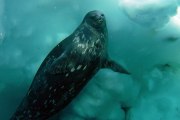
Amy Klink, a graduate student working in the laboratory of Dr. Allyson Hindle at the University of Nevada, Las Vegas, has been studying hypoxia tolerance of Weddell seals. These remarkable animals can hold their breath for 90 minutes and dive as deep as 900 meters! During such long and deep dives, these seals slow down their heart rate and constrict blood vessels in visceral as well as peripheral organs. As […]
Continue Reading →

Some organisms self-destruct after reproduction

Most mammals are iteroparous, meaning they can undergo multiple cycles of reproduction and gradually advance in age. In stark contrast, semelparous species only reproduce once before they die, as the physiological toll of mating is quite high. Examples of semelparous species include Pacific salmon, which swim upstream where they die after spawning, thus becoming nutrients for their own offspring and the environment. By only 10 months of age, male kalutas […]

Continue Reading →

Males are not always bigger…unless they are northern elephant seals

A new study published in Nature Communications challenges the popular notion that males are usually bigger than females – at least in mammals. Their findings are consistent with Dr. Katherine Ralls who also challenged this idea in the late 1970s. In this new study, researchers looked at data collected for 429 species of animals. Rather than using averaged values from the literature, they turned to large-published datasets that included values […]

Continue Reading →

Nature’s architects

Nature has already solved many problems that doctors, researchers, and architects are still trying to solve for humans. For example, some of our prior posts have talked about how some animals are resistant to developing cancer: Elephants Tasmanian devils Naked mole rats Other animals have developed special nano antibodies (nanobodies) to fight disease. Llamas While several are tolerant of very low oxygen levels in the environment, others are champions of […]

Continue Reading →

Individuality in woodpeckers

Animals, like people, have unique sounds that allow them to recognize individuals. For example, you can hear a great spotted woodpecker calling in the first portion of this YouTube video below. In another YouTube video, we see a great spotted woodpecker doing what woodpeckers do best…pecking at wood. Woodpeckers peck (i.e. drum) to ward off rivals as well as attract mates. In a new study published in PLoS ONE, researchers examined […]

Continue Reading →