Tag Archive for ‘opioid’

Physiology on the road: 17th annual Arizona Physiological Society conference

Physiologists in Arizona also shared their research this past weekend at the 17th annual Arizona Physiological Society conference held at the University of Arizona in Tucson. 2024 Arizona Physiological Society Established Scientist Keynote Address The Established Scientist Keynote Address was given by Dr. Meredith Hay, Professor and former Executive Vice President and Provost of The University of Arizona in Tucson. Dr. Hay also served as President of the American Physiological […]

Continue Reading →

Physiology on the Road: What’s happening in the Midlands

The Midlands Society of Physiological Sciences held their annual conference on October 21st at the University of Nebraska Medical Center. The Keynote Lecture was given by Dr. Manolis Kellis, Professor at Massachusetts Institute of Technology. He spoke about the use of artificial intelligence approaches to examine how fly and human genes are regulated. Other highlights: Anuj Singh (University of Nebraska Medical Center): Opioid use is a major healthcare concern and […]

Continue Reading →

Ohio is talking about fixing broken hearts, the physiology of freezing, combating opioid addiction and more

The Ohio Physiological Society held their 33rd Annual Meeting at the University of Cincinnati this weekend. The keynote address was given by Dr. Mark Sussman from San Diego State University. He spoke about current research strategies that aim to improve the ability for the heart to repair itself after heart failure. Dr. Perwez Alam (University of Cincinnati) also spoke about using siRNA to try to repair heart tissue after heart attacks and […]

Continue Reading →

Centipede Analgesics

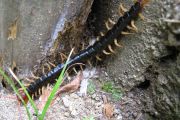
In the face of the current opioid crisis, scientists are searching for new and safer painkillers (analgesics). Venomous animals may be useful in the search as their venom can contain peptides with analgesic properties. In fact, researchers recently discovered and characterized an analgesic peptide, dubbed SsmTX-I, that was isolated from the venomous centipede, Scolopendra subspinipes mutilans. This peptide was shown to block a type of potassium channel (Kv2.1) in the body that is involved in sensing […]

Continue Reading →

What a pain!

I read an interesting review article published recently in Physiology. The review discussed how various animals sense pain. Perhaps understanding how animals detect pain will lead to better pain management techniques for animals and humans.    Our bodies have special sensors, called nociceptors, that detect noxious stimuli that could injure tissues. Stimulation of these receptors is what allows you to move your hand away from a hot stove even before your […]

Continue Reading →

Centipede venom blocks pain more effectively than morphine

Researchers from the Chinese Academy of Sciences and The University of Queensland have discovered a venom from centipedes capable of blocking pain more effectively than morphine! According to the study authors, centipedes have appeared in the fossil records as far back as 430 million years. They are also one of the first land-dwelling creatures to use venom to incapacitate their prey as shown in the image above of a Chinese […]

Continue Reading →