Extreme Animals

Don’t let that cute little face fool you…
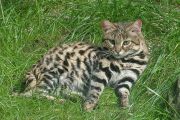
This is not your Grandmother’s cat. Despite its seemingly domesticated look, this cute feline is a fierce hunter. Black-footed cats are the smallest wild felines in Africa coming in at only 14-20 inches long, 8 inches in height and weighing only 2-6 pounds. They are also considered the deadliest feline on Earth. Say what??? Turns out this Napoleonic cat is known for killing more prey in one night (10-14 rodents […]

Continue Reading →

Alligator snorkeling

I read an interesting article in Live Science about a unique way a group of American alligators use to survive periods of freezing water, for a few days at least. As the temperature drops, the animals stick their nose out of the water and are thus able to breathe through the ice. During cold months the alligators also reduce their metabolism, a process called brumation, which is different from hibernation […]

Continue Reading →

Watch out T Rex…

Researchers used supercomputers in a new study to see who had the toughest bite…the winner? ….drumroll… the finch! By examining bite force and body mass, researchers found that if finches were the same size as a T Rex, their bite would be 320 times stronger than the ancient dinosaur’s bite. In fact, finches evolved amazing bite strength given their small body size. Source: Live Science  

Continue Reading →

Time to talk turkey

Just in time for Thanksgiving… While wild turkeys are known to spend time in the snow, I read an interesting article about the effects of cold exposure on livestock during transport. According to the article, nearly all livestock animals are transported at some point in their life, which can be pretty stressful to the animals. In fact, some turkeys lose weight during transport and others do not even make it […]

Continue Reading →

What do hibernating animals and astronauts have in common?

Well, nothing yet…but imagine the possibilities of human spaceflight if we could put people into a form of stasis? While short term stasis-like states have been used in medical settings, the idea of putting people into stasis to allow long term space travel – without intensive physician oversight, remains a major goal of space agencies and companies like Spaceworks (above). Scientists at the Comparative Physiology meeting considered this very question, […]

Continue Reading →

Dangers of eating greens

Dr. Kevin Kohl (University of Pittsburgh) gave an interesting talk at the conference on the various dangers of eating plants. Aside from having low protein content and large quantities of indigestible fibers, plants are great sources of toxic chemicals. Remarkably, many animals have evolved to eat plants that may be toxic to other animals. Research by Dr. Kohl suggests that the gut microbiome of these animals may have evolved to […]

Continue Reading →

Improving tissue integrity for transplants

Ground squirrels are known for their remarkable ability to tolerate hypothermic conditions. Humans are not. Dr. JingXing Ou (National Institutes of Health) presented an interesting talk that explored using induced pluripotent neuronal stem cells isolated from these mammalian hibernators to improve tissue integrity for organ transplants. By understanding which pathways protected ground squirrel cells from cold-damage, these pathways could be manipulated in human induced pluripotent neuronal stem cells and improve […]

Continue Reading →

Hypoxia and anoxia and reoxygenation, Oh my!

There are many examples of animals that can naturally tolerate hypoxic and anoxic conditions without exhibiting pathologies associated with reoxygenation. Here are a few examples from this year’s conference: Dr. Anthony Signore (University of Nebraska) spoke about how some hypoxia tolerant animals can use carbon monoxide, you know that gas we think of as poisonous, to improve oxygen binding to hemoglobin in hypoxic conditions. Well known for their ability to […]

Continue Reading →