
Pets infected with Covid rarely make headlines, although the US Department of Agriculture’s National Veterinary Services Laboratory is tracking cases as part of its One Health Initiative. The goal of this initiative is to recognize the connections between people, plants, animals, and the environment they share to promote optimal health. Covid, for example, not only infects humans but has also been detected in cats, dogs, ferrets, wild animals (deer), as well as animals residing in zoos (e.g. tigers, lions, gorillas, snow leopards, otters, spotted hyenas, mink, cougars, lynx, mandrill, squirrel monkeys, coati, binturong). Understanding how diseases impact animals and are transferred both within and between species is very important in stopping the spread of disease. Moreover, as diseases often impact species differently, understanding natural resistance can lead to treatments and prevention strategies.
Pets are beloved members of many households and, as such, come into close contact with humans. With respect to Covid, a study published in Science early on in the pandemic found that pigs, chickens, and ducks were not very susceptible to contracting Covid. The risk of infection in dogs was also low and the virus did not replicate well in our canine companions. Although disease transfer between cats was low, the virus was detected in the upper airways of cats and was found to cause inflammation in the lungs. Covid was also detected in the upper airways of ferrets, but like cats, disease transmission between animals was low.
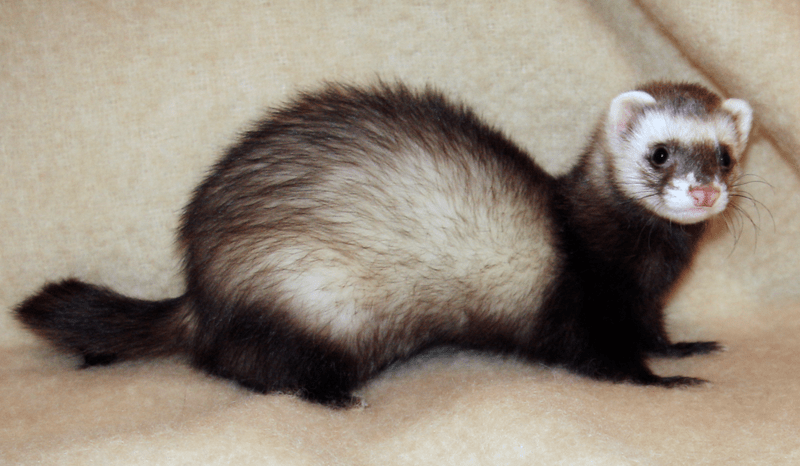
Ferrets and humans have a lot in common when it comes to respiratory anatomy and physiology. Like humans, ferrets also develop sneezing and coughing when they contract a respiratory illness. Ferrets are also susceptible to contracting Covid which results in mild symptoms including fever and respiratory inflammation. Because the spread of Covid between animals is low, ferrets can provide insight into new strategies to reduce the spread of the disease in other species (Zhao et al., 2023).
As with many illnesses, Covid doesn’t affect everyone the same way. Like humans, female ferrets are less likely to develop severe illness or death from Covid but are more likely to develop long Covid symptoms than males. Cardiovascular disease is the most common complication of Covid infection. In a new study published this month in the American Journal of Physiology – Heart and Circulatory Physiology, researchers at the University of Guelph (Ontario, Canada) examined sex differences in how Covid affects the cardiovascular system. They discovered that even though ferrets developed mild symptoms, and the virus was not detected in their hearts or lungs, sex differences in the molecular stress responses in the hearts of female and male ferrets was observed. For example, females had higher levels of p62 protein in their hearts early in the infection, which is thought to spark a faster immune response and protection from severe cardiac complications. In addition, females had lower activity of an enzyme important in viral replication. However, females were more prone to developing fibrotic lesions in their hearts 2 weeks after contracting Covid.
These results further support the need to consider sex differences in managing Covid treatments and the risk for long-term Covid symptoms in pets (at least in ferrets) and people.
Sources:
S Rouhana, K Jacyniak, ME Francis, D Falzarano, AA Kelvin, WG Pyle. Sex differences in the cardiac stress response following SARS-CoV-2 infection of ferrets. American Journal of Physiology – Heart and Circulatory Physiology. 325(5): H1153-H1167, 2023.
J Shi, Z Wen, G Zhong, H Yang, C Wang, B Huang, R Liu, X He, L Shuai, Z Sun, Y Zhao, P Liu, L Liang, P Cui, J Wang, X Zhang, Y Guan, W Tan, G Wu, H Chen, Z Bu. Susceptibility of ferrets, cats, dogs, and other domesticated animals to SARS-coronavirus 2. Science. 368(6494, 1016-1020, 2020.
USDA One Health Initiative: https://www.aphis.usda.gov/aphis/ourfocus/onehealth/onehealth
Y Zhao, C-L Wang, Z-Y Gao, H-X Qiao, W-J Wang, X-Y Liu, X Chuai. Ferrets: A powerful model of SARS-CoV-2. Zoological Research. 44(2): 323-330, 2023.
- Physiology on the road: What’s happening in Arizona
- New paper explores how our complex kidneys evolved
Categories: Comparative Physiology
 Life Lines by Dr. Dolittle
