
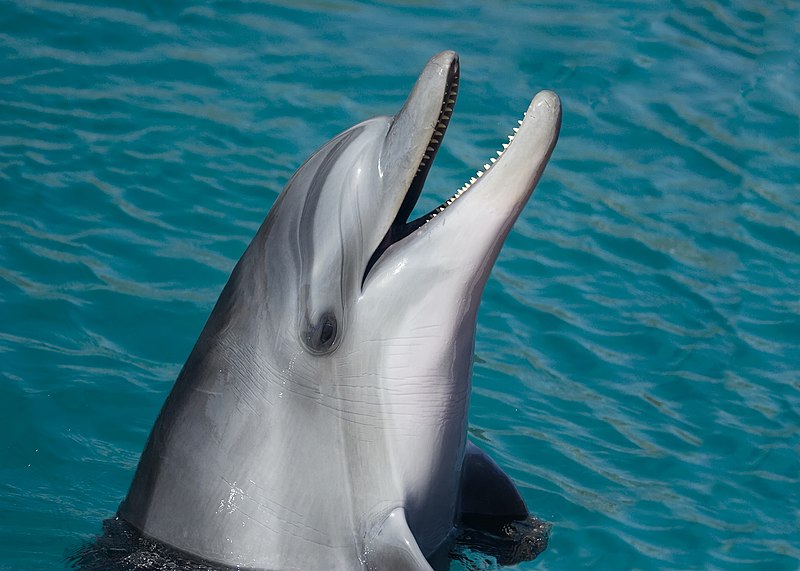
The risk of developing cardiovascular disease increases with aging as arteries can become increasingly stiff and the inner lining, called the endothelium, can become dysfunctional. Postdoctoral fellow Dr. Yara Bernaldo De Quiros Miranda (University of Las Palmas de Gran Canaria) is interested in understanding how bottlenose dolphins, Tursiops truncatus, protect their cardiovascular system during aging. She is currently a visiting scholar at the University of Colorado at Boulder where she is supported by a Marie Curie Fellowship. She presented her research on cardiovascular aging at the 2024 American Physiology Summit held in Long Beach, California last month.
Yara’s research has shown that the blood of young adult humans differs from that of middle-aged to older adults. In fact, if you expose mouse arteries to serum collected from middle-aged to older adult humans, the mouse arteries begin to act like aging arteries. This means that circulating factors in the blood of people are at least partly responsible for causing age-associated cardiovascular disease. That also means that it may one day be possible to identify circulating factors that help reduce risk.
Dolphins are yet another diving mammal, like Weddell and elephant seals, with remarkable hypoxia tolerance. With each dive and extended breath-holding, their tissues become hypoxic. As they resurface, oxygenation to tissues is restored. These cycles of hypoxia and reoxygenation are similar to a human or other animal experiencing a stroke, heart attack, or blood clot. Yet, unlike humans, these cycles are perfectly normal for a dolphin. In fact, they are rather long-lived and do not typically develop age-associated cardiovascular diseases. Yara’s research is focused on trying to figure out whether they have circulating factors that protect their blood vessels as it may lead to new discoveries to prevent or treat cardiovascular aging in other mammals.
Source:
Yara Bernaldo De Quiros Miranda “The bottlenose dolphin (Tursiops truncatus): A novel model for
studying healthy vascular aging“, 2024 American Physiology Summit, Long Beach, CA.
Categories: Aging, Comparative Physiology, Hibernation and Hypoxia, Nature's Solutions, Ocean Life, Physiology on the Road
Tags: American Physiological Society, American Physiology Summit, dolphins, fitness, health, heart, heart-health, lifestyle
 Life Lines by Dr. Dolittle
