
With the multitude of anti-aging products on the market today, it may be hard to believe that humans are one of the longest-living mammals. Why organisms age and how to slow down this process, or at least ensure that organisms stay healthy as they age, has been on the minds of many researchers over the years.
Now, an international team of researchers called the Mammalian Methylation Consortium, led by Dr. Steve Horvath and colleagues at the University of California at Los Angeles, has been searching for a universal mammalian “biological signature” that would allow them to estimate the age of an organism’s tissues by looking at changes in their tissue DNA. Findings from this consortium of scientists, described in a press release from UCLA, have shown that long-lived mammals have complicated patterns of DNA methylation, which are epigenetic changes that happen to DNA and allow cells to control the expression of genes (Haghani et al., Science. 2023). Such complicated patterns are thought to have arisen because long-lived animals have lengthy gestation and development periods compared to short-lived species.
By collecting such epigenetic data from over 15,000 tissue samples representing 348 species of mammals, the team is now able to search for links between lifespans, aging, and DNA methylation. In comparing these links, they found that changes in DNA methylation are correlated with the maximum life span of mammals. They were also able to develop a mathematical “universal clock” for mammals that could be used to estimate the age of a given species based on data for 185 species. Moreover, the team discovered specific regions of DNA that gains or loses methylation with advancing age and found that certain developmental pathways were associated with tissue degeneration and aging (Lu et al., Nature Aging, 2023).
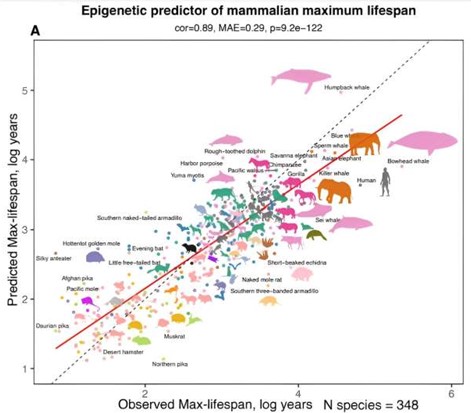
In a new study published this month in the journal Science Advances, the research team discovered that their mathematical algorithm is not only useful in predicting the maximum lifespan of mammals, even for species not included in their analyses, they were also able to use the algorithm to predict the gestation length and the age at which species become sexually mature. Interestingly, despite some research suggesting that caloric restriction may increase lifespan, the team found no changes in their calculated maximum lifespan when taking into consideration such diets. However, it is important to note that the algorithm was not able to predict maximum lifespan variations between individuals that were from the same species. In other words, maximum lifespan estimates are unique to each species but do not provide accurate information on an individual’s lifespan or risk of mortality.
Sources:
A Haghani et al., DNA methylation networks underlying mammalian traits. Science. 381: eabq5693, 2023.
AT Lu, A Fei, A Haghani et al., Universal DNA methylation age across mammalian tissues. Nature Aging. 3: 1144-1166, 2023.
CZ Li, A Haghani, Q Yan, AT Lu, J Zhang, Z Fei, J Ernst, XW Yang, VN Gladyshev, TR Robeck, AS Chavez, JA Cook, JL Dunnum, K Raj, A Seluanov, V Gorbunova, S Horvath. Epigenetic predictors of species maximum life span and other life-history traits in mammals. Science Advances. 10(23): eadm7273, 2024.
- Advancements in veterinary wound healing
- Even shy animals find overcrowded conditions more stressful than bold animals
Categories: Aging, Extreme Animals, Nature's Solutions
Tags: Aging, DNA methylation, health, lifespan, longevity, science
 Life Lines by Dr. Dolittle