

Devils Hole pupfish (Cyprinodon diabolis) are a tiny critically endangered fish that live in a pond in just one limestone cave, known as Devils Hole, in Death Valley, Nevada. In fact, their habitat is the smallest known for a vertebrate.
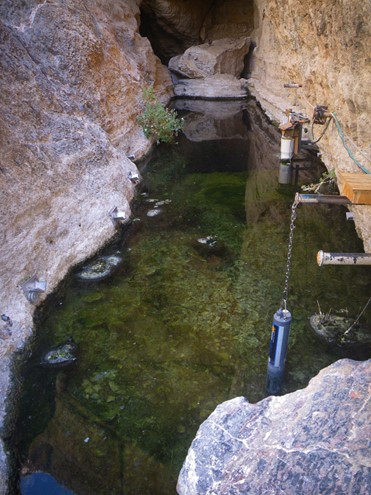
Biologists from the Nevada Department of Wildlife, US Fish and Wildlife Service and the National Park Service have been painstakingly counting these tiny fish twice a year. Counting these fish is not easy as their habitat includes both shallow and deep water, up to 30 meters, requiring scuba gear.

Living in such a desert environment also presents unique physiological challenges for these fish as the water temperature can get as high as 34ºC resulting in hypoxic conditions. The fish rely on a small shallow shelf, a mere 11 x 16 feet in size, for spawning and food as the depths do not receive much sunlight. Adaptations to such a small habitat with limited food resources have resulted in a lower metabolic rate that allows these animals to feed mainly on the algae found in the shallow region of their habitat.
Efforts to protect the local groundwater and supplement their diet when needed with food pellets have paid off. In fact, their most recent population count of 191 observable fish is the largest recorded in the past 25 years, up from only 35 fish in 2013, but down from 200-250 fish in the 1990s. To help ensure the long-term survival of this species, biologists have also developed a captive breeding program to establish a backup population.
Source:
- Researchers discover how hibernating ground squirrels protect their cells from self-destruction
- Stress is contagious, even for dogs
Categories: Climate Change, Environment, Extreme Animals, Hibernation and Hypoxia, Nature's Solutions
Tags: biodiversity, conservation, Devils Hole, Environment, nature, pupfish, wildlife
 Life Lines by Dr. Dolittle
.jpg)