
On this “National Polar Bear Day”, we explore how these formidable animals keep warm.
Arctic polar bears, Ursus maritimus, live in very cold environments where temperatures are often colder than a home freezer and can dip as low as -40 degrees C. They thrive on ice and routinely hunt and swim in ice-cold water. Unlike humans, and many other mammals for that matter, polar bears have several characteristics that help keep them warm. According to Polar Bears International, their huge feet have thick pads with small bumps, known as papillae, as well as strong claws which help keep their feet warm and prevent them from slipping on the ice. They also have two layers of fur to help retain body heat and shield them from the cold air. In addition, their ears and tails are small, which helps prevent heat loss.
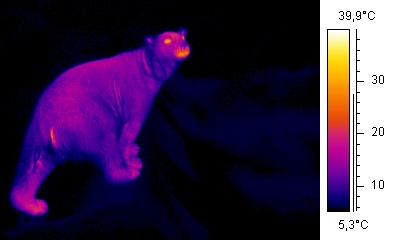
A new study was inspired by noticing that polar bears are hard to detect with infrared cameras (see photo above). This means that the temperature of their fur closely matches their environment. Reasons behind their resistance to freezing sparked a new research study that was published last month in Science Advances.
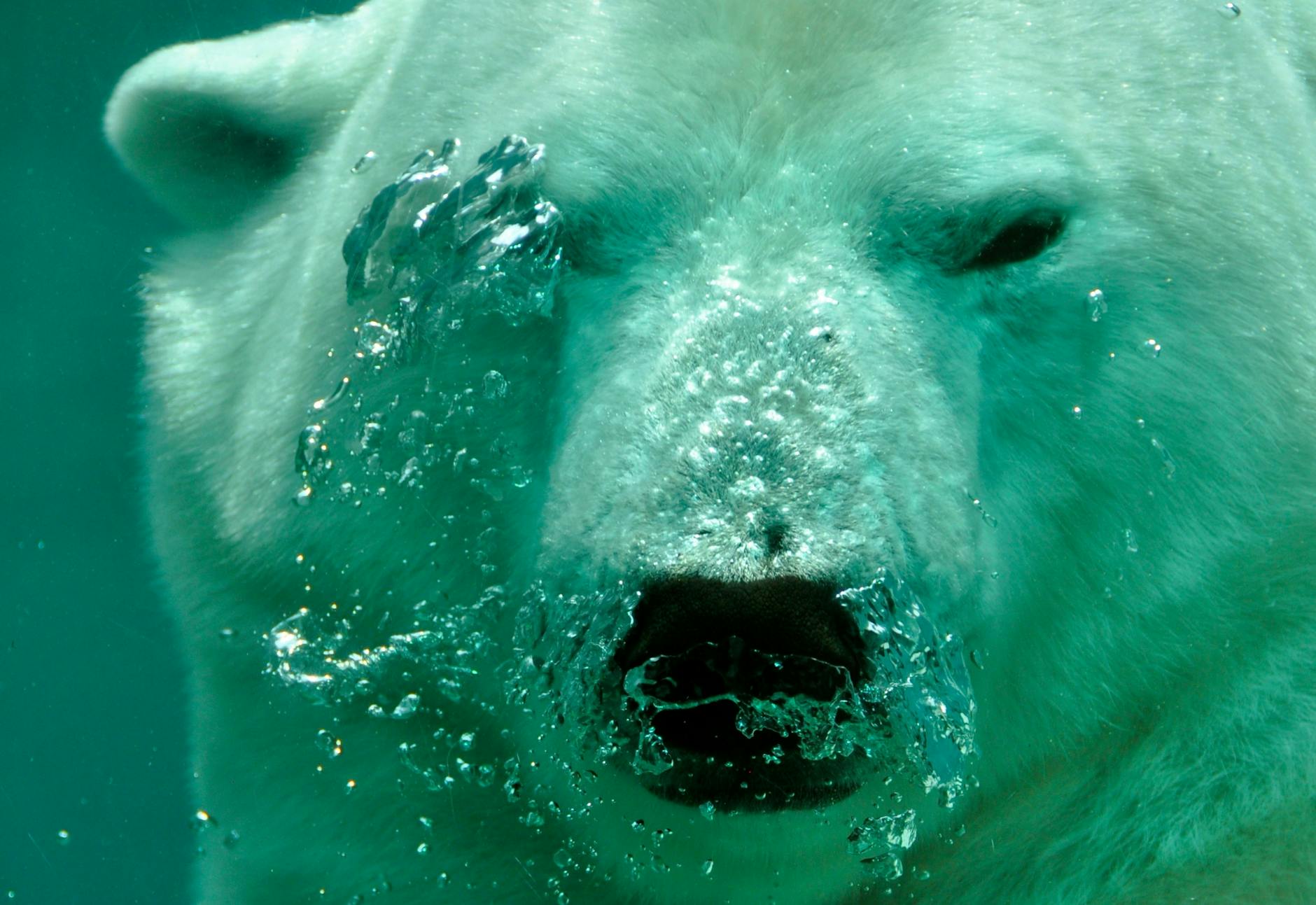
In this new study, an international team of scientists led by Dr. Bodil Holst (University of Bergen) discovered that polar bears secrete a special oil from their skin that is made up of cholesterol, fatty acids, and diacylglycerol. Because these ‘greasy’ compounds are water-repellant, they prevent water from accumulating and forming ice in the animal’s fur. The oil also helps them to make very little noise while swimming so they can sneak up on seals, their main food source.
Sources:
J Carolan, M Jakubec, NF Xavier Jr, AP Motala, E Bifulco, J Aars, M Andersen, AL Schmidt, MB Cabré, V Singh, PE Colavita, EW Selfors, M Sacchi, S O’Reilly, Ø Halskau, MK Tiwari, RG Hobbs, B Holst. Anti-icing properties of polar bear fur. Science Advances. 11(5): eads7321, 2025.
Categories: Comparative Physiology, Environment, Extreme Animals, Hibernation and Hypoxia, Most Popular, Nature's Solutions
Tags: animals, Arctic, biology, nature, polar bear, wildlife, winter
 Life Lines by Dr. Dolittle