
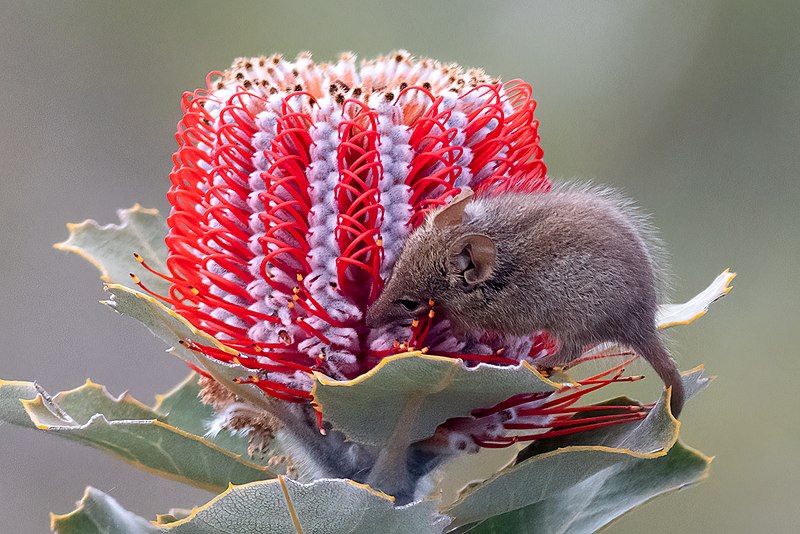
Meet the honey possum (Tarsipes rostratus). These animals are small and rather unusual marsupials with few teeth and a specially adapted tongue to aid in the consumption of a diet consisting of only nectar and pollen. Because they feed primarily at night, rely on fresh flowers, and tend to stress easily, they are difficult to study. In fact, their adrenal gland, which produces the stress hormone cortisol, weighs about 1,600 mg/kg body mass. Compare that to other marsupials that have adrenal glands weighing only 100-200 mg/kg body mass. With this in mind, it is probably not surprising, that levels of cortisol in their feces are about a thousand times higher than other marsupials and increase even more if they are handled.
Similar to nectarivorous bats, honey possums must consume a lot of nectar and pollen to maintain energy balance. As such, they are important pollinators. Honey possums are also known to undergo torpor during which time they reduce their metabolism to conserve energy. Although, their torpor habits are not well-known.
Honey possums have an unusual gut as well. They do not have a cecum and their stomach has a side pocket called a diverticulum. Research also suggests that they might be missing the ability to produce acid in their stomach to aid in digestion.
Source:
D Bradshaw, F Bradshaw. The physiology of the honey possum, Tarsipes rostratus, a small marsupial with a suite of highly specialized characters: A review. Journal of Comparative Physiology B. 182: 469-489, 2012.
- Cardioprotective adaptations to high altitude
- Leaf extract shows promise in model of Alzheimer’s Disease
Categories: Diet and Exercise, Environment, Extreme Animals, Stress
Tags: adaptation, evolution, Honey possum, physiology, Stress
 Life Lines by Dr. Dolittle
