
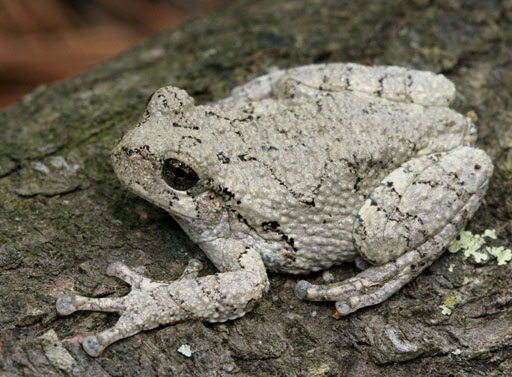
Cope’s gray treefrogs, Dryophytes chrysoscelis, are remarkable animals that can actually survive being frozen…multiple times each year. In fact, these animals live in an environment in which temperatures commonly dip below freezing. When temperatures drop, up to 65% of their body water literally freezes. In anticipation of freezing temperatures, they begin to accumulate cryoprotectant chemicals during the fall to help protect their organs.
Until now, the effects of repeated cycles of freezing and thawing on their physiology have not been studied. For this reason, researchers sought to compare the effects of three cycles of freezing and thawing, a single freezing episode, or simple acclimation to cold (but not freezing) temperatures on their physiology.
The researchers discovered that the animals exposed to repeated cycles or just a single episode of freezing had accumulated more cryoprotectants, especially glycerol, than animals that were simply acclimated to the cold. Interestingly, animals that were quick to recover from being frozen metabolized more glycogen and mobilized more glycerol after freezing, but also showed more signs of red blood cell damage. In contrast, those that used less glycogen and mobilized less glycerol recovered more slowly, but also had less red blood cell damage. What was also really interesting about their findings is that the animals did not necessarily need to store large amounts of cryoprotectants in order to survive repeated cycles of freezing.
In contrast to these treefrogs, most species are not able to survive freezing. Even so, some people have paid a lot of money to companies offering to cryopreserve their bodies after death in the hope of being regenerated someday in the future. Mimicking the successes of nature, their bodies are typically pumped with cryoprotectants. While the science of cryonics today is much more sophisticated than its disturbing origins, it is still not possible to successfully revive cryogenically preserved humans. In fact, in an attempt to discover what happens to cryogenically-preserved remains upon thawing, scientists discovered not only cracked skin, but also fractures in almost all organs along with ruptured blood vessels. At present, successfully reviving people-sicles is not very promising. But, who knows what the future will hold.
Sources:
EE Yokum, M Wascher, DL Goldstein, CM Krane. Repeated freeze-thaw cycles in freeze-tolerant treefrogs: novel interindividual variation of integrative biochemical, cellular, and organismal responses. American Journal of Physiology – Regulatory, Integrative and Comparative Physiology. 324(2): R196-206, 2023.
Categories: Aging, Extreme Animals, Hibernation and Hypoxia, Illnesses and Injuries, Intelligence and Neuroscience, Nature's Solutions
Tags: American Journal of Physiology, American Physiological Society, cryogenics, Freeze tolerance, frog, physiology, winter
 Life Lines by Dr. Dolittle
