
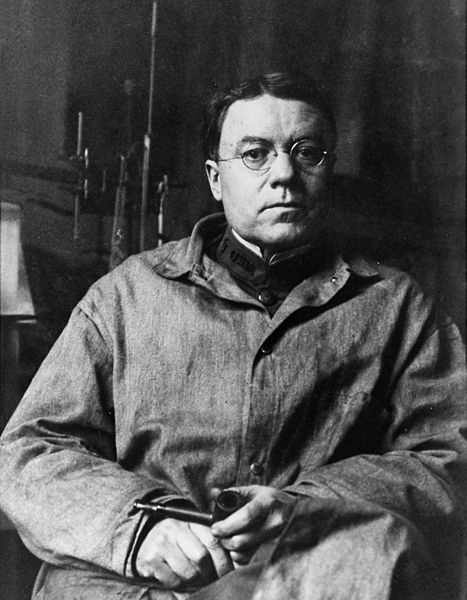
In this time machine post, we travel back to 1929 to discuss an article written by Dr. Walter B. Cannon, published in Physiological Reviews. Among other achievements, Dr. Cannon is perhaps best known for being the first to coin the term “homeostasis” and to describe “fight or flight responses” in organisms.
As a review article, Dr. Cannon summarized observations made by others about how organisms appear to “maintain their own stability” and “cure” their own diseases. Dr. Cannon shared a quote from Dr. Claude Bernard that was stated in 1878, “It is the fixity of the ‘milieu interieur’ which is the condition of free and independent life…All the vital mechanisms, however varied they may be, have only one object, that of preserving constant the conditions of life in the internal environment.” Dr. Cannon referenced this quote to highlight the understanding at the time that organisms are able to maintain a relatively constant internal state around certain set points. Dr. Bernard suggested that organisms need to regulate water, temperature, oxygen, as well as nutrients such as salt, sugars and fats within narrow limits.
In his 1929 essay, Dr. Cannon expanded on these early descriptions and included not only those described by Dr. Bernard, but also proteins, calcium, ‘internal secretions’, osmotic pressure as well as the concentration of hydrogen ions. Even though organisms are exposed to various external stressors such as pathogens and environmental factors (heat, cold, predators, etc), healthy organisms are able to physiologically adjust to these stressors and maintain relatively normal “internal conditions”, which he termed, homeostasis. Diseases arise when organisms are not able to successfully restore homeostasis.
Dr. Cannon described “homeostasis by regulating supplies” as one method by which organisms maintain homeostasis. In this example, organisms have a way to store excess “supplies” and a method to tap into those supplies if they run low. An example of this would be the storage of excess fats in adipose tissue or glucose in the liver. If fatty acids or glucose concentrations in the blood run low, such as occurs during fasting, organisms are able to access fat and glucose stores to return levels to physiological. The body also regulates hunger and thirst, which allows it to control the intake of nutrients and water to help ensure homeostasis and the availability of these nutrients. In turn, if an organism takes in more nutrients or water than the body can use or store, the excess is excreted either in urine or feces to again maintain a relatively constant internal environment. If homeostasis is not maintained, however, then conditions such as obesity, diabetes, and dehydration, (among others) can occur.
Temperature regulation is another excellent example used by Dr. Cannon to describe the body’s remarkable ability to maintain homeostasis. In mammals, an increase in body temperature results in several homeostatic responses such as sweating or panting, increased thirst, and behavior changes including seeking shade or cooler environments. All of these responses serve to help lower body temperature to normal ranges. A decrease in body temperature, on the other hand, results in shivering to produce heat and seeking warmth such as cuddling, shelter, and in the case of humans, warmer clothes.
In 1932, Dr. Cannon expanded on his ideas and authored a book titled, The Wisdom of the Body, which is an excellent read.
Each year, the American Physiological Society (APS) recognizes an outstanding physiologist for “original lifetime achievements” with The Physiology in Perspective Walter B. Cannon Award Lectureship. Recipients of the award are invited to give a lecture at the annual APS Summit (formerly Experimental Biology conference) describing their research as it relates to The Wisdom of the Body and homeostasis. The 2024 recipient was Dr. Sadis Matalon from the University of Alabama at Birmingham who studies lung injury and repair. Stay tuned to see who the 2025 recipient of this award will be at the APS Summit next April…
Sources:
Walter B. Cannon. Organization for Physiological Homeostasis. Physiological Reviews. 4(3): 399-431, 1929.
Claude Bernard. Lectures on the Phenomena of Life Common to Animals and Vegetables. Springfield, IL: Charles C. Thomas, 1974.
- From Hibernation to Healing: Unlocking Genomic Secrets for Human Therapies
- Physiologists in California meet today to discuss the latest research
Categories: Climate Change, Comparative Physiology, Environment, Extreme Animals, Nature's Solutions, Stress, Time Machine
Tags: American Physiological Society, Cannon, Fight or flight, health, homeostasis, medicine, nutrition, Physiological Reviews, Stress, wellness
 Life Lines by Dr. Dolittle