
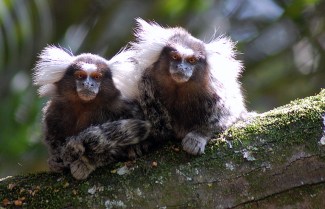
Image of common marmosets by Dario Sanches – via Wikimedia commons
A new review article published in the American Journal of Physiology – Regulatory, Integrative and Comparative Physiology explored an interesting question: how do prenatal experiences along with the intrauterine environment impact the future development of pediatric and adult obesity in animals? Common marmosets (Callithrix jacchus) are New World monkeys that can spontaneously develop obesity early in life when living in captivity with high food availability and relatively low physical activity. Similar to humans, obese marmosets are prone to developing high blood sugar and cholesterol as well as nonalcoholic fatty liver disease and arteriosclerosis.
Marmosets can reproduce about twice a year and with each pregnancy, they can carry litters of 2-4 offspring. The size of a litter a female can carry depends on her body weight, i.e. higher body weight is associated with a higher number of ovulations each menstrual cycle. The problem is that when a female is pregnant with more than 2 offspring, the maternal resources are not proportionally increased. This results in fetal demand that outweighs the maternal resources so the infants are born at lower birth weights compared with twins.
Aside from diet and physical activity, researchers are beginning to discover that the intrauterine environment can impact metabolism and future risk for metabolic diseases, like obesity. In obese marmosets, greater abilities to store fate becomes apparent by 1 month of age. In addition, exposure to a high fat diet is not necessary for the obese phenotype to emerge, rather it appears to be more related to the body mass of the mother. These observations suggest that obesity may, at least in part, be programmed in the womb.
Source:
Riesche L, Tardif SD, Ross CN, deMartelly VA, Ziegler T, Rutherford JN. The common marmoset monkey: avenues for exploring the prenatal, placental, and postnatal mechanisms in developmental programming of pediatric obesity. American Journal of Physiology – Regulatory, Integrative and Comparative Physiology. 314(5): R684-R692, 2018. https://doi.org/10.1152/ajpregu.
Categories: Diet and Exercise, Reproduction and Development
Tags: #AJP, American Journal of Physiology, APS, marmoset, Obese, obesity, physiology, pregnancy
 Life Lines by Dr. Dolittle
This is such an insightful topic! It’s amazing how pediatric obesity in marmoset monkeys can actually start developing before birth. It really shows how important maternal nutrition and health are—not just for humans, but for animals too.
Marmosets Finger Monkeys For Sale
LikeLike