
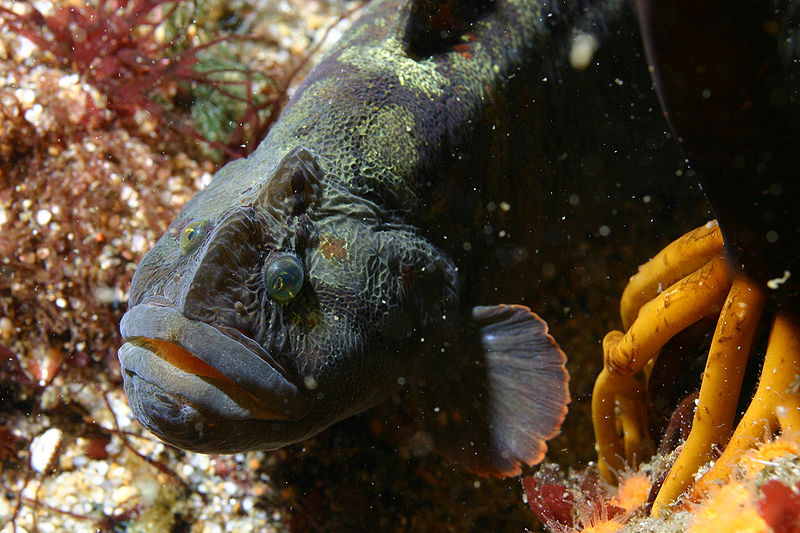
Someone must have seen a resemblance to monkeys when naming these animals. Adult monkeyface pricklebacks, Cebidichthys violaceus, weigh around 6 pounds and can grow up to 2.5 feet long. They can live up to about 18 years of age. Despite their appearance, they are not eels, although their eel-like shape allows them to hide in crevices. They are native to the California coast and their home range is only a few meters. What is really cool about them is that they are able to survive on land up to 35 hours as long as they are moist. This is a really useful trait for an animal that often is found in tidepools. Unfortunately, that is not a useful trait when avoiding fishermen. In fact, they are considered quite delicious by some chefs.
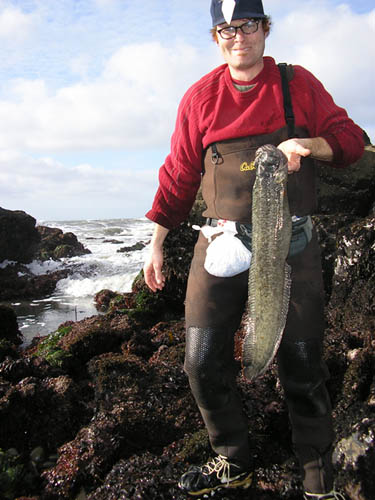
As monkeyface pricklebacks develop, they transition from a mostly carnivorous diet when they are young to a mostly herbivorous diet as adults. Naturally, researchers were curious about how various diets impact their gut microbiome. So, they fed freshly captured animals either an herbivorous, omnivorous, or carnivorous diet for 6 months and compared their gut microbiomes to wild fish. What they found was surprising – the gut microbiome of monkeyface pricklebacks fed an omnivorous diet was similar to wild fish, whereas the gut microbiome of fish fed a carnivorous or herbivorous diet were not. Perhaps their microbiome did not need to shift with their changing diet as it was already suited for digesting various foods? Their findings were presented at the 2023 American Physiology Summit in Long Beach this past spring.
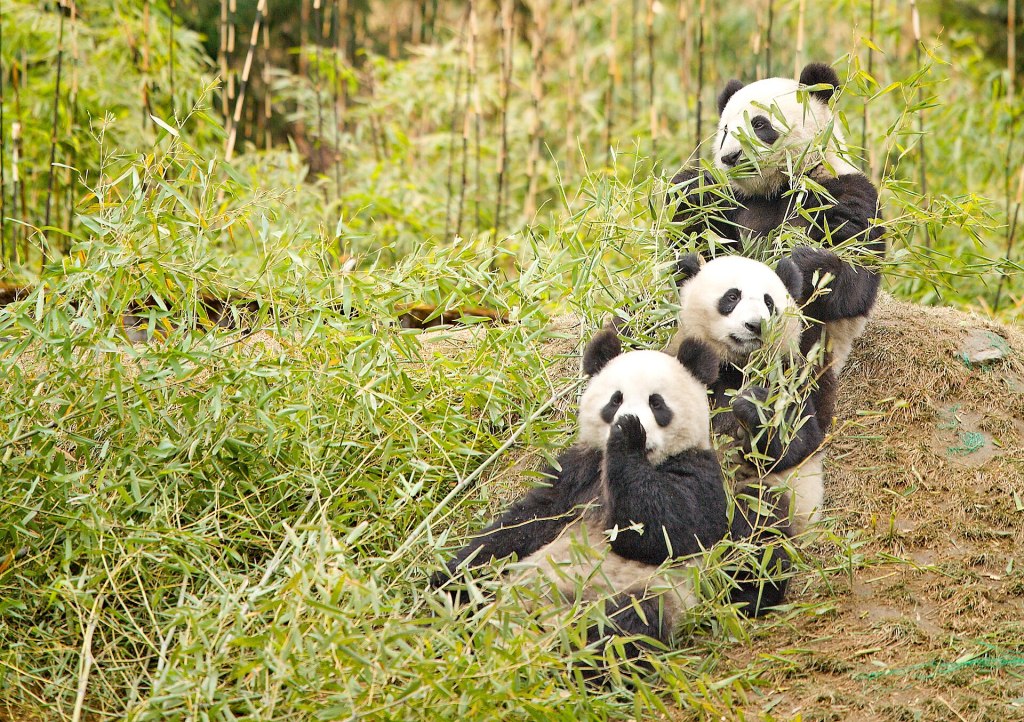
What is equally fascinating is that the gut microbiome of another herbivore, the giant panda (above), is quite similar to a carnivore (like its ancestors). These findings, published in mBio, suggest that their gut microbiome did not shift with their adaptation to a plant-based diet either. In fact, giant pandas have a low abundance of bacteria responsible for digesting plant fibers. Crazy, for an animal that relies on bamboo!
Sources:
M Herrera, J Heras, C Catabay, K Connor, D German. Dietary-induced changes in the hindgut microbiome and metabolism of a marine herbivorous fish. 2023 American Physiology Summit Meeting Abstracts. Physiology. 38(S1).
Z Xue, W Zhang, L Wang, R Hou, M Zhang, L Fei, X Zhang, H Huang, LC Bridgewater, Y Jiang, C Jiang, L Zhao, X Pang, Z Zhang. The bamboo-eating giant panda harbors a carnivore-like gut microbiota, with excessive seasonal variations. mBio. 6(3): e00022-15, 2015.
- Scientists find clues to tissue regeneration and aging in Hydractinia
- The physiology of ‘frogsicles’ and the quest for life after death
Categories: Aging, Agriculture, Aquaculture, and Livestock, Diet and Exercise, Ocean Life, Physiology on the Road
Tags: American Physiological Society, American Physiology Summit, animal, diet, fish, physiology, Prickleback
 Life Lines by Dr. Dolittle


