
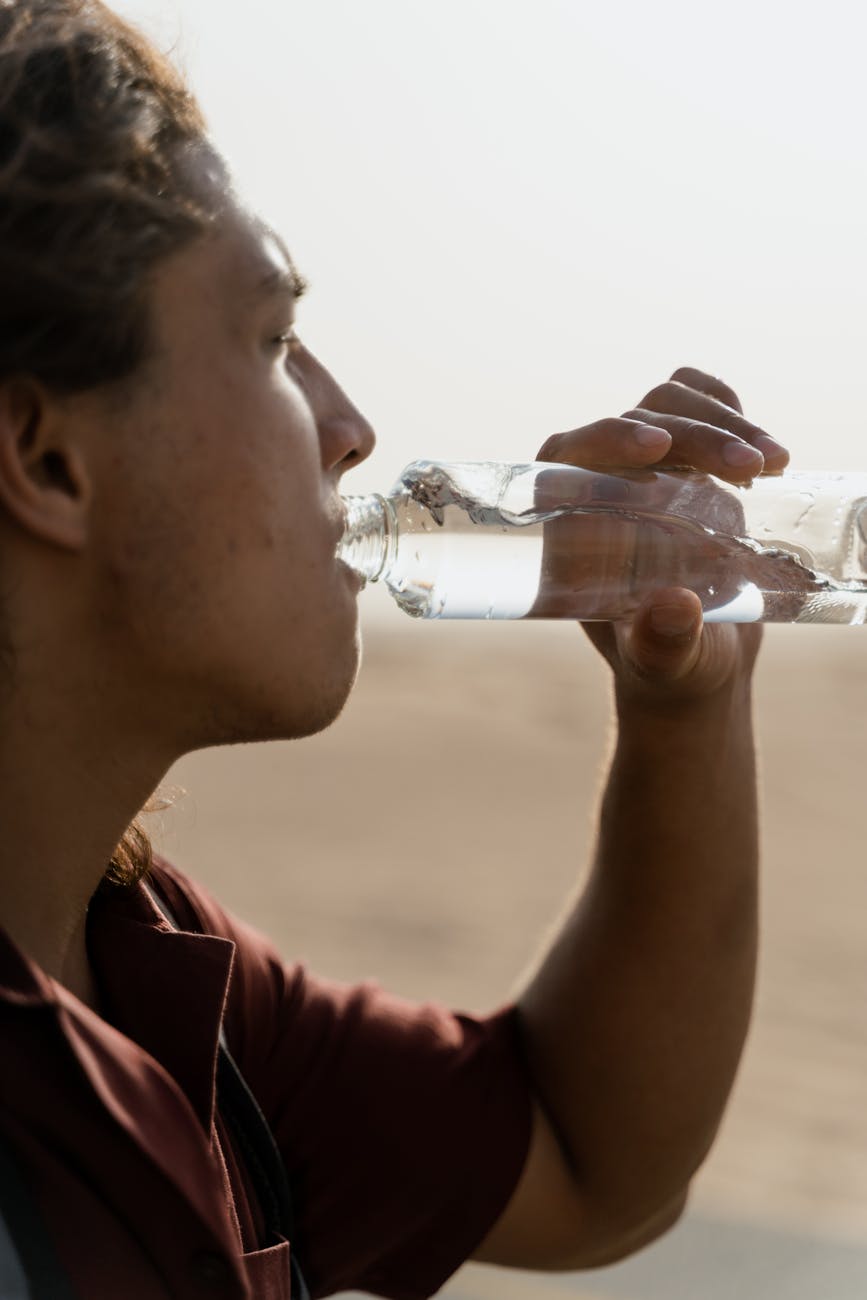
You’ve probably heard the term “dehydration”, but have you heard about “anhydremia”? We obtain water through food and drinks as well as metabolism. In fact, metabolic processes account for about 5-10% of water input (Lorenzo et al., 2019). We lose water daily through evaporation, breathing, urine, and feces. If an organism loses more water than they ingest, or can produce through metabolic processes, the water volume in their blood declines resulting in dehydration and hypovolemia (Riebl and Davy, 2013). The term for such a drop in blood volume used to be called “anhydremia”. This was the subject of an article published in Physiological Reviews in 1923 (Marriott, 1923).
According to the review article, metabolism of 100 grams of fat can make about 90-110 grams of water whereas a similar amount of carbohydrates or proteins produce 55-60 and 40-45 grams of water, respectively. If cellular water becomes severely depleted, then tissues and organs in the body can become dehydrated as water is pulled from the cells in attempt to maintain water volume in the blood (and hence blood pressure) (Marriott, 1923). Most of the body’s stored water is found in muscles (about 70-75% of muscle mass) and muscles as well as skin are the first to lose water during dehydration (Lorenzo et al., 2019). While excessive water loss from muscles can impair function, loss from the blood can damage organs and lead to death.
Water needs are highly variable between species. Humans are not as well-adapted as say, a hibernating animal that may go months without water, or a camel that can store large volume of water to survive in arid conditions. In a prior post, we also that long-distance migratory birds create metabolic water from fat and protein metabolism to prevent dehydration.
Time for a water break!
Sources:
I Lorenzo, M Serra-Prat, JC Yebenes. The role of water homeostasis in muscle function and frailty: A review. Nutrients. 11(8): 1857, 2019.
SK Riebl, BM Davy. The hydration equation: update on water balance and cognitive performance. ACSMs Health Fit J. 17(6): 21-28, 2013.
WM Marriott. Anhydremia. Physiological Reviews. 3(2): 275-294, 1923. https://doi.org/10.1152/physrev.1923.3.2.275
Categories: Environment, Extreme Animals, Illnesses and Injuries, Nature's Solutions, Time Machine
Tags: American Physiological Society, dehydration, metabolism, Physiological Reviews, water
 Life Lines by Dr. Dolittle