
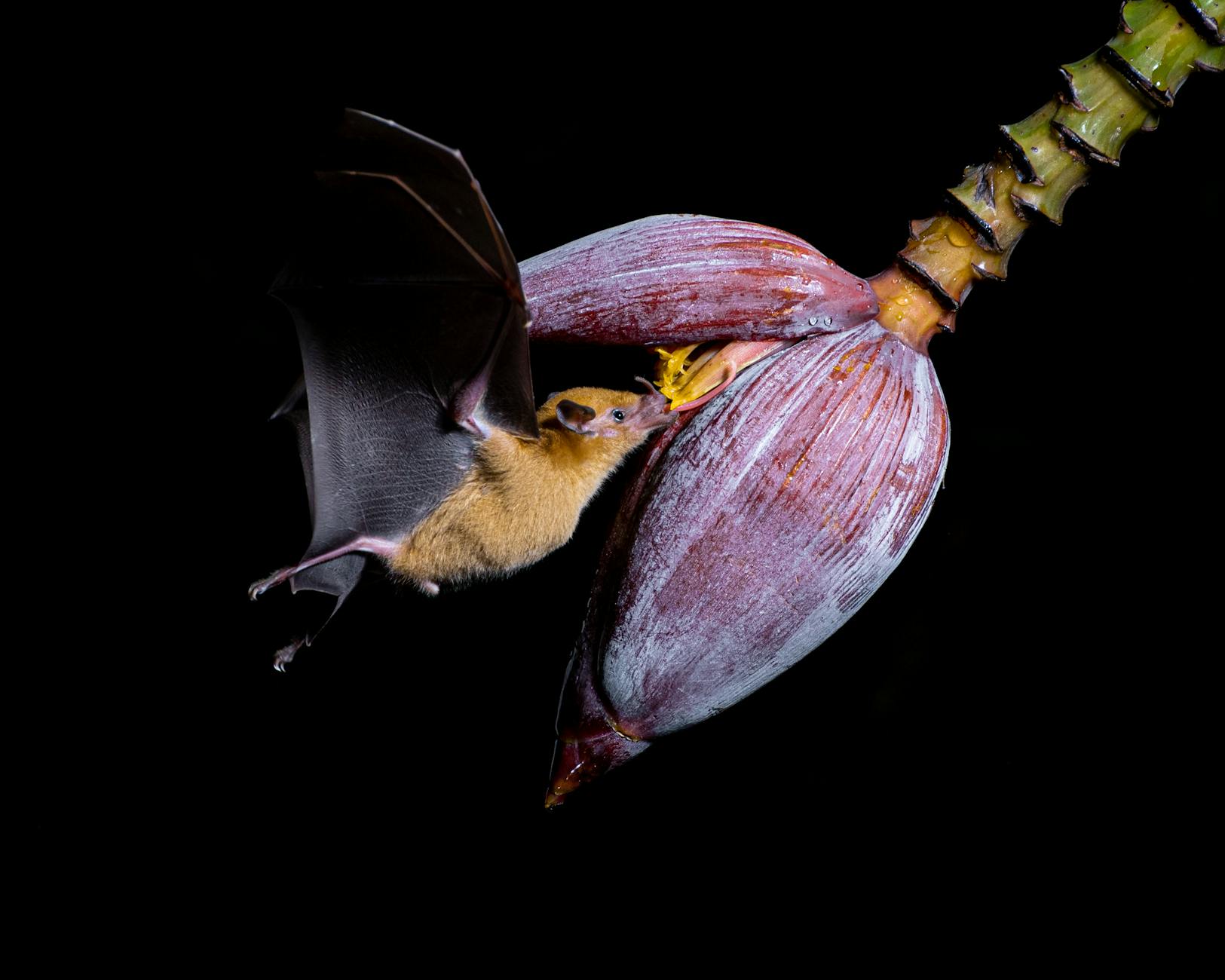
A reference to nectar-feeding bats as “hummingbirds of the night” in a presentation at the 2025 American Physiology Summit in Baltimore last month caught my eye. What an appropriate nickname for bats that can have blood sugar levels exceeding 750 mg/dl after a meal! Sure, a hummingbird would think this was normal, but for a human these levels would warrant a trip to the emergency room. New research shared by first author Dr. Jasmin Camacho (Stowers Institute for Medical Research) explored how nectar-eating bats regulate their blood sugar.
In mammals, much of the glucose consumed during a meal ends up in skeletal muscle and adipose tissue. Naturally, the research team examined how the muscles of nectar bats deal with all that sugar. They discovered that muscles in nectar-eating bats are resistant to insulin. Despite this resistance, their muscles are still capable of taking up glucose from the blood in response to muscle contractions – such as flight – thanks to specialized glucose transporters that function independently of insulin. Once inside the cells, glucose can be rapidly metabolized with any extra glucose converted into triglycerides (Camacho et al., 2025). Similar to nectar-eating bats, fruit bats also have high blood sugar after a meal. Since nectar-eating and fruit bats spend so much time foraging, however, they are able to control their blood sugar levels pretty well through muscle contractions (Kelm et al., 2011; Peng et al., 2017).
What is truly remarkable about both nectar-eating bats and hummingbirds is that they have long lifespans for their body size – even with all that blood sugar (Kelm et al., 2011). If only we could all be “hummingbirds of the night”.
Sources:
J Camacho, V Pena, A Bernal-Rivera, F Deng, B Yang, N Rohner. Muscle adaptations to hyperglycemia enable nectar bats to thrive on a sugar-rich diet. 2025 American Physiology Summit Abstracts, Baltimore, MD.
DH Kelm, R Simon, D Kuhlow, CC Voigt, M Ristow. HIgh activity enables life on a high-sugar diet: blood glucose regulation in nectar-feeding bats. Proc Biol Sci. 278(1724): 3490-3496, 2011. doi: 10.1098/rspb.2011.0465
X Peng, X He, Q Liu, Y Sun, H Liu, Q Zhang, J Liang, Z Peng, Z Liu, L Zhang. Flight is the key to postprandial blood glucose balance in the fruit bats Eonycteris spelaea and Cynopterus sphinx. Ecol Evol. 7(21): 8804-8811, 2017.
- The electrophysiology of sudden cardiac death in high-performance athletes
- Discovered by accident: Queen bumblebees can hibernate underwater!
Categories: Diet and Exercise, Exercise, Extreme Animals, Nature's Solutions, Physiology on the Road
Tags: American Physiological Society, American Physiology Summit, animals, Bats, diet, food, fruit, glucose, health, nectar, nutrition, wellness
 Life Lines by Dr. Dolittle