
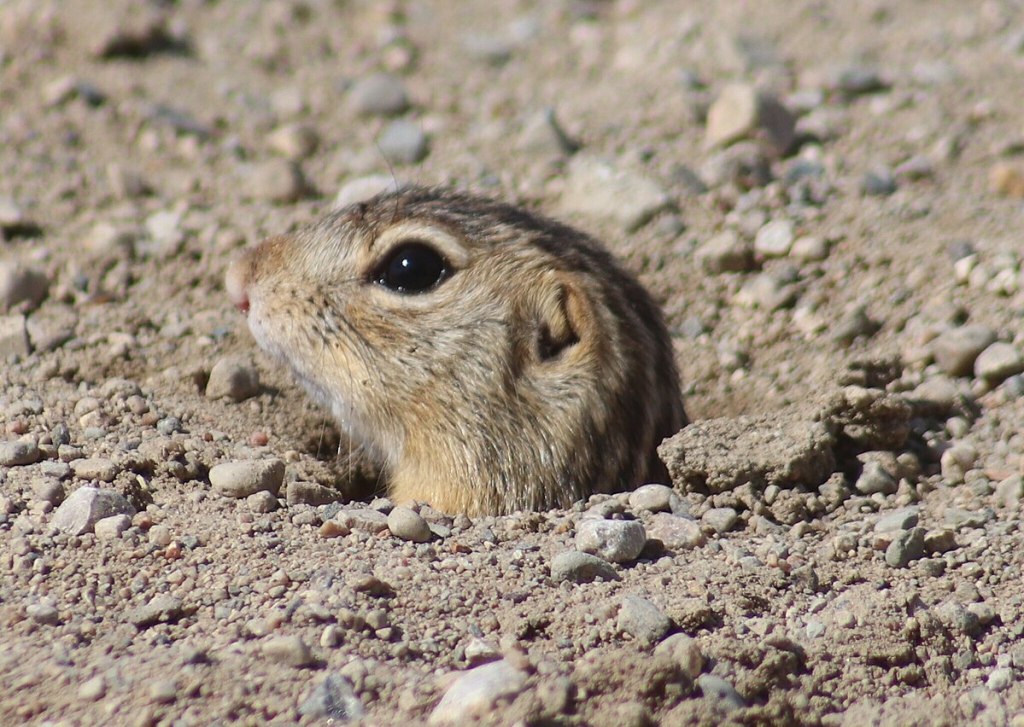
I am thrilled to have come across a calendar of fun and interesting “holidays” for all sorts of occasions, including celebrating nature and the animals around us. In honor of ‘National Squirrel Appreciation Day’, let’s take a moment to marvel at furry survival experts and the incredible science behind winter slumber in ground squirrels.
When temperatures drop, ground squirrels settle down for a long winter’s nap. During hibernation, their bodies cycle between phases of extreme energy conservation, called torpor, and short periods of arousals when their body temperature and metabolism returns to non-hibernating levels. This amazing ability to hit the metabolic “pause” button requires some unique physiological tricks.
Golden-mantled ground squirrels (Callospermophilus lateralis), for example, are true hibernation champions. Their body temperature can drop close to freezing, and their metabolism slows to a mere 1/100th of its usual rate during torpor. Researchers recently discovered that when these squirrels experience torpor in warmer temperatures (~20°C), they develop more changes in the expression of genes – affecting thousands of genes in the heart, liver, and kidneys – compared to non-hibernating animals maintained at 20-25°C. This suggests that warmer temperatures might lead to greater dysregulation of metabolic processes as compared to freezing temperatures. These findings were presented at the 2024 American Physiology Summit in Long Beach, California (Crippen et al., 2024).
Another “cool” trick of hibernating animals is muscle preservation. In most non-hibernating animals, long periods of inactivity lead to muscle loss, but ground squirrels have a special way of keeping their muscles intact. Scientists studying Arctic ground squirrel quadriceps muscles found that, while the expression of a gene related to muscle loss was increased early in hibernation, their muscle size (measured as cross-sectional area) and fiber type remained stable throughout the remainder of hibernation. This means they are able to wake up in the spring ready to forage (Goropashnaya et al., 2024).
Preparation for hibernation also requires changes in the gut as the animals overeat and fatten up to provide energy during their long winter nap. As 13-lined ground squirrels (Ictidomys tridecemlineatus), prepare for hibernation, their gut microbiome changes and becomes mildly inflamed. Researchers wondered if reducing inflammation with a medication called budesonide would affect their gut health. Sure enough, the treatment reduced both inflammation and the diversity of gut bacteria as they prepared for hibernation, indicating that inflammation may drive changes in the gut microbiome as the animals prepare for hibernation (Grond et al., 2024).
Want to learn more? Check out this “cool” podcast from Physiological Genomics, which dives even deeper into how the liver adjusts to hibernation in ground squirrels:
Sources:
T Crippen, D Barth, Z Carlson, F van Breukelen, AG Hindle. Torpor in the golden-mantled ground squirrel: investigating transcriptomic dynamics across body temperature. Physiology. 39(S1): May 2024.
AV Goropashnaya, AL Confides, IY Bergua, KL Drew, AA Dupont-Versteegden, VB Fedorov. Skeletal muscle preservation in arctic ground squirrels during hibernation season. Physiology. 39(S1): May 2024.
K Grond, JZ Tulod, CC Kurtz, KN Duddleston. Effects of the anti-inflammatory drug budesonide on the gut microbiota and cytokine production of 13-lined ground squirrels during prehibernation fattening. Physiological Genomics. 56(11): 711-720, 2024.
K Robichaud, B Duffy, JF Staples, PM Craig. Mitochondrial microRNA profiles are altered in thirteen-lined ground squirrels (Ictodomys tridecemlineatus) during hibernation. Physiological Genomics. 56(8): 555-566, 2024.
- Time Machine: Do horses produce more heat per day than humans, and what happened to Tusko?
- Brain Power on a Budget: How Bullfrogs Survive Without Oxygen
Categories: Climate Change, Environment, Extreme Animals, Hibernation and Hypoxia, Most Popular, Nature's Solutions
Tags: American Physiological Society, American Physiology Summit, animals, ground squirrel, hibernation, National Squirrel Appreciation Day, nature, Physiological Genomics, wildlife, winter
 Life Lines by Dr. Dolittle