
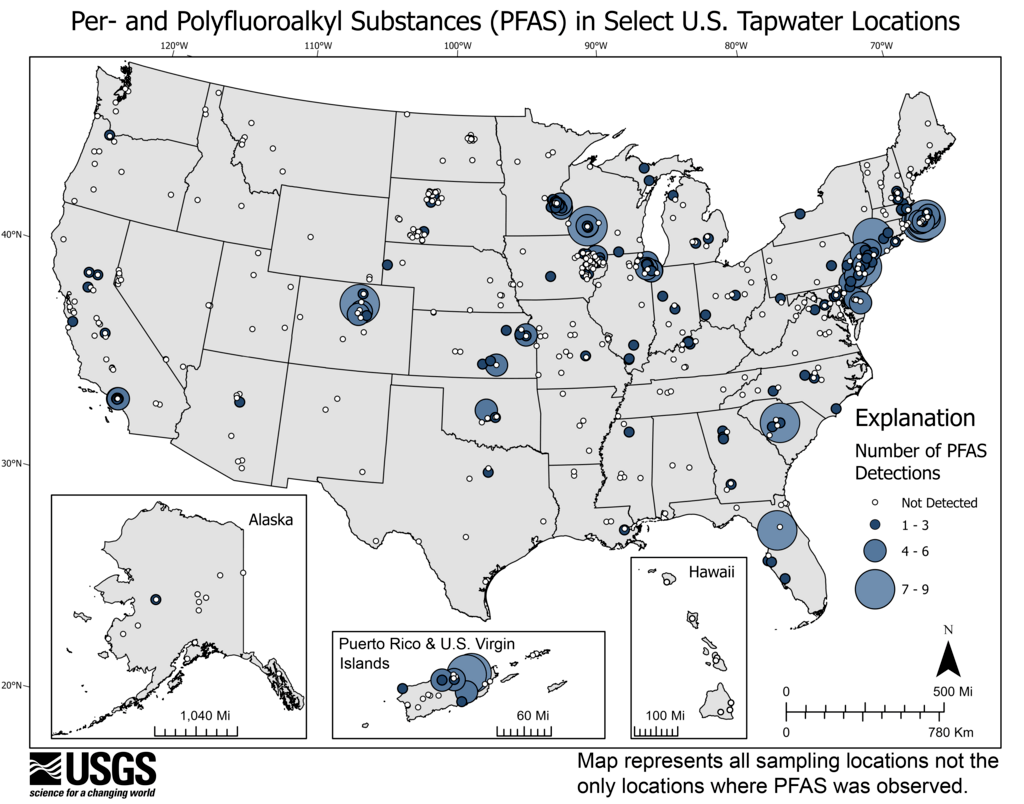
It seems that we are learning more every day about potential exposure to “forever chemicals”, such as PFAS. From proposed laws in California that would ban PFAS in cookware and other items to maps such as the one above showing potential contamination in tap water. These chemicals are drawing so much attention because they do not break down easily and can remain in the environment for decades. In addition, PFAS exposure has been linked to various reproductive disorders and cancers.
In a new study, scientists measured the levels of PFAS in tree swallows and the insects they eat to determine whether the chemicals were harmful and how they move through the food chain. Samples were collected from sites near military bases and comparison sites along the East Coast and in the Upper Midwest, and their findings were published in the journal Environmental Toxicology and Chemistry.
PFAS levels were highest at military and airport training areas where firefighting foams have been used, as well as in urban areas. In some locations, PFAS levels were up to 40 times higher than those measured at nearby reference sites!
Although birds are exposed to PFAS through drinking water, the researchers found that the main route of exposure was through eating contaminated insects. In fact, the levels of PFAS measured in insects closely mirrored levels detected in eggs and nestlings.
Despite detecting measurable levels of PFAS in the eggs and nestlings, the team did not find any clear links between exposure and egg hatching or nestling survival, suggesting exposure did not cause reproductive harm at these levels. They also found no evidence that PFAS exposure altered markers of immune system or hormonal regulation in the birds. Although this study showed that tree swallows appear to be resistant to harmful effects associated with PFAS, it should be noted that the researchers only examined a handful of biomarkers. Even so, avian resilience to such harmful chemicals is impressive and sets birds apart from other species in which PFAS have been shown to cause cancer and impair reproduction.
Source:
CM Custer, PM Dummer, S Schultz, N Karouna-Renier, CW Matson. Tree swallows as indicators of per- and polyfluoroalkyl substance exposure and effects at select Department of Defense sites along the East Coast and at sites with different sources in the Upper Midwest, Unites States. Environmental Toxicology and Chemistry. [In press] DOI: 10.1093/etojnl/vgaf207
- How exercise and age change muscles
- Primed for survival: How sea hares inspire new clues to protect the brain from low oxygen conditions such as stroke
Categories: Environment, Extreme Animals, Urbanization
Tags: airport, birds, contamination, egg, Environment, Forever chemicals, health, PFAS, tree swallows, urban, water
 Life Lines by Dr. Dolittle